
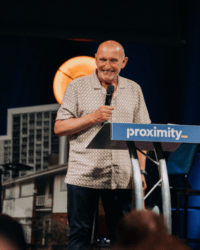
This article is not written as a personal attack on Andy Hawthorne, nor is it about personalities, popularity or denominational differences. It is a theological examination of published material, documented practices and the biblical responsibility of Christians to exercise discernment.
The starting point is Hawthorne’s own account in Diary of a Dangerous Vision, particularly the description on pages 181–182 of an apparent communication from his deceased brother to his dying father. Whatever explanation is ultimately given for that experience, Scripture provides a clear standard by which such experiences must be tested. Christians are not permitted to make personal spiritual experiences their authority. The Word of God must remain the final authority.
From there, this article examines the labyrinth and its documented historical and contemporary associations, before considering its promotion within Christian and Hope-related material. The purpose is not to claim that every person who has ever walked a labyrinth has consciously practised occultism, nor that every Christian who has encountered one understands its wider history. The issue is whether the church should deliberately adopt a spiritual practice whose documented uses and associations include magic, divination, Neo-paganism, goddess spirituality, dowsing, earth spirituality and other forms of alternative spirituality.
That distinction is important. The question is not simply what someone intended by a practice, but whether that practice is biblically appropriate for the people of God. Scripture commands, “Beloved, believe not every spirit, but try the spirits whether they are of God” – 1 John 4:1 (KJV), and again, “Prove all things; hold fast that which is good” – 1 Thessalonians 5:21 (KJV). Therefore, this article asks Christians to do precisely that: test the claims, examine the sources, compare the practices with Scripture, and then draw conclusions accordingly. The standard is not whether something is popular, emotionally powerful, visually beautiful or described as Christian; the standard is the Word of God.
Andy Hawthorne’s Unrepentant Necromancy
The term necromancy, from the Hebrew expression dōrēš ’el-hammētîm, meaning one who inquires of or consults the dead, is directly relevant to the account given in Diary of a Dangerous Vision. On pages 181–182, Andy Hawthorne describes his family singing as his father was dying and recounts his mother seeing a picture in her mind of his father being picked up and carried into a beautiful garden.
He then describes the voice of his deceased brother, who had died the previous year, speaking to his dying father: “Hey George, come in, it’s wonderful here” (Diary of a Dangerous Vision, pp. 181–182).
Hawthorne identifies the voice as that of his deceased brother, and these are not words attributed to him by a critic; they appear in his own published account. The question, therefore, is not whether the experience was emotionally comforting, but whether such an experience should be accepted as genuine spiritual communication from the dead.
Scripture gives a clear answer: “There shall not be found among you any one that maketh his son or his daughter to pass through the fire, or that useth divination, or an observer of times, or an enchanter, or a witch, or a charmer, or a consulter with familiar spirits, or a wizard, or a necromancer: for all that do these things are an abomination unto the LORD” – Deuteronomy 18:10–12 (KJV).
The biblical prohibition is not optional; God’s people were forbidden to seek spiritual communication from the dead. Isaiah gives the same warning: “And when they shall say unto you, Seek unto them that have familiar spirits, and unto wizards, that peep, and that mutter: should not a people seek unto their God? for the living to the dead?” Isaiah 8:19 (KJV). The biblical principle is straightforward: the living are to seek God, not the dead. That makes the account in Diary of a Dangerous Vision profoundly concerning.
Whatever explanation one gives to the experience, whether psychological, mistaken perception, or something genuinely spiritual, the Christian response should never be to accept communication attributed to the dead without testing it against Scripture: “Beloved, believe not every spirit, but try the spirits whether they are of God” – 1 John 4:1 (KJV). The problem is therefore not the experience itself, but the absence of clear biblical discernment around it.
Where is the warning that Christians must not seek or receive communication from the dead? Where is the biblical testing? Where is the repudiation of the experience? Instead, the account appears within the story of Hawthorne’s Christian ministry and spiritual journey. That matters because once subjective spiritual experiences are accepted without first being subjected to Scripture, a dangerous principle can emerge: if an experience feels spiritual, comforting or profound, it can be treated as something from God.
But Scripture never gives personal experience that authority. Jeremiah warns: “The heart is deceitful above all things, and desperately wicked: who can know it?” – Jeremiah 17:9 (KJV). The Christian does not test Scripture by experience; we test experience by Scripture. That principle becomes increasingly important when examining the spiritual practices that later appeared within the wider networks associated with Hawthorne, from the Worldwide Message Tribe and The Message Trust through Eden, Hope 08 and Hope Together. One particularly important example is the labyrinth.
The Spiritual Practice Behind the Labyrinth
The issue cannot honestly be reduced to saying that a labyrinth is merely artwork, a walking exercise or an attractive pattern on the floor. In Labyrinths: Ancient Paths of Wisdom and Peace, Virginia Westbury documents a remarkably broad range of historical and contemporary religious uses of the labyrinth. On page 15, Westbury writes, “Labyrinths have a strong tradition in magical, protective devices and symbolic entrances” (Labyrinths: Ancient Paths of Wisdom and Peace, p. 15). She also explains that modern psycho-spiritual interpretations are relatively recent and that labyrinths have served different purposes throughout history. That historical background matters when the same basic practice is subsequently introduced into Christian prayer.
Westbury’s account becomes even more explicit on page 17, where she describes “Lovers of nature, Neo pagans and Dowsers” using labyrinths to connect with what they understand as streams of energy within the earth. She discusses divination, healing, eco-spirituality, nature mysticism and the ancient Earth goddess. These are not simply Christian concepts expressed using different terminology; they belong to a much wider spiritual environment.
On page 19, Westbury records the purposes people give for walking labyrinths, including meditation, spiritual connection, talking to God, “talking to spirit,” self-exploration, healing, sensing energy, wisdom, worship, divination, inner peace, transformation and communication with others. She also describes people from very different religious backgrounds using labyrinths: Christians, Muslims, Jews, Buddhists, Neo-pagans, New Agers and people with no religious beliefs.
Within that environment, people may bring beliefs involving crystals, karma, angels, spirits, Jesus, Buddha, Kali, Allah, God the Father, God the Mother or no God at all. That should cause a Christian to stop and ask a fundamental question: Why is a practice capable of accommodating such radically different spiritual systems being introduced as a Christian method of prayer?
Occult and Earth-Spirituality Associations
Westbury’s documentation continues throughout the book. On page 33 she discusses potential shamanic uses of labyrinths, including magic, vision quests, initiation and rites of passage, seasonal celebrations, fertility rites, oracles and death-and-rebirth symbolism.
She describes historical contexts involving priests, healers, soothsayers and magicians. On page 35, she discusses the labyrinth as a sacred mountain and a place associated with the relationship between humans and gods, along with imagery of caves, wombs, and rebirth. On page 43 she connects labyrinth traditions with mystery religions, including spiritual journeys, esoteric practices and initiation into mysteries.
On page 44 she describes Scandinavian labyrinth traditions, including the “Maiden’s Dance,” fertility symbolism and magical protective functions. On page 51, she discusses church labyrinths, including the labyrinth at Chartres Cathedral, and describes theories that church labyrinths functioned as “protective devices, ritual gateways and sanctuaries” (Labyrinths: Ancient Paths of Wisdom and Peace, p. 51).
The question for Christians is therefore unavoidable: Where does the New Testament instruct believers to approach God through a ritual gateway? Jesus did not tell His disciples to walk a sacred pathway in order to enter God’s presence. He said, “I am the way, the truth, and the life: no man cometh unto the Father, but by me” – John 14:6 (KJV). Christ is the way. Not a labyrinth.
The Labyrinth as a Spiritual Device
Westbury’s discussion of modern labyrinth spirituality becomes even more significant on pages 79–80. On page 79, she describes the labyrinth as a “spiritual device” for finding deeper meaning in life and encountering the divine, whatever a person conceives the divine to be.
On page 80, she describes labyrinths being used within churches as aids to body-centred forms of prayer, including dance and ritual, and refers to mystical experiences involving communion with a divine force and spirit energies.
This is where the issue goes beyond history. The question is no longer simply, “Did ancient people use labyrinths?” The question becomes, “What spiritual function is this practice being given today?” If a labyrinth is being used as a method of prayer, meditation, spiritual reflection or encountering the divine, then it has become a spiritual practice. And spiritual practices must be tested by Scripture. Putting the words Jesus, Bible, prayer or Christian around an existing spiritual methodology does not automatically establish that God has authorised it.
Dowsing, Goddess Spirituality and Nature Spirits
Pages 89–90 of Westbury’s book take the issue further. Westbury discusses Alex Champion, described as a dowser and professional labyrinth maker, and describes his involvement with earth-based spirituality, dowsers, goddess worshippers and Neo-pagans. The labyrinth is discussed in connection with focusing earth energies and connecting with spirits associated with nature. Westbury also describes rituals connected with solstices and equinoxes and an ancient goddess figure. Champion describes experiences associated with labyrinth walking, including vivid dreams, euphoria, visions, and physical sensations.
Again, the issue isn’t that everyone who walks a labyrinth necessarily believes these things. The issue is that the labyrinth movement itself documents these spiritual interpretations. Christians therefore cannot simply pretend that the labyrinth has no spiritual history beyond Christian prayer. The same physical form is being used within radically different spiritual systems. That does not prove that every Christian who walks a labyrinth is consciously practising paganism, but it does create a serious question of biblical discernment: Should Christians deliberately adopt a spiritual practice whose documented uses include magic, divination, goddess spirituality, dowsing, earth energies, shamanic practice and communication with spirits?
From the Labyrinth Movement into Christian Practice
This becomes particularly important when we examine the Hope material. In Hope: Heartbeat of the Mission, the “Harvest Labyrinth” is presented as a “12th century ritual” adapted for the twenty-first century. The labyrinth is described as a winding path inviting people to walk slowly, stopping at different points for reflection, interaction and prayer concerning their spiritual journey, their relationship with God, the community and the planet.
It is recommended for use in a church or church hall and can be combined with a Harvest supper or community activity. The suggested journey uses imagery involving soil, seeds, watering, growing plants, harvesting wheat, grinding wheat into flour and making bread. Participants are encouraged to interact, reflect and pray at different points, with Bible texts used to draw parallels between the seed and the Christian spiritual journey (Hope: Heartbeat of the Mission, p. 124).
The same basic concept appears in Hope for the Harvest, page 97. Then, in Hope in Our Towns, Villages and Cities (p. 86), the material explicitly recommends “using a prayer labyrinth.” It describes three stages: an inward journey, a centre for prayer and meditation, and an outward journey concerning one’s relationship with the world (Hope in Our Towns, Villages and Cities, p. 86). In Hope for the Future, page 118, Leicester Cathedral’s overnight programme is described as including bands, prayer graffiti, walks, a prayer labyrinth and Taizé-style meditation (Hope for the Future, p. 118).
So this is not merely a historical discussion of labyrinths. The labyrinth was being presented as something that could be used for Christian prayer, meditation, spiritual reflection and community outreach. That is precisely where the biblical question becomes unavoidable.
“But We Put Jesus in It”
One of the easiest ways to defend practices like this is to say, “We’re not using it like pagans. We’re using it for Jesus.” But that does not answer the biblical question. The question is not simply what words we attach to a practice. The question is whether God has given His church authority to use that practice as a spiritual discipline in the first place.
Israel was repeatedly warned against adopting the religious practices of surrounding nations and simply redirecting them towards the LORD. The New Testament likewise warns believers, “Beware lest any man spoil you through philosophy and vain deceit, after the tradition of men, after the rudiments of the world, and not after Christ” – Colossians 2:8 (KJV).
Christianity is not improved by taking a spiritual practice from somewhere else and adding Christian terminology to it. The church does not need to borrow spirituality from paganism, New Age religion, mystery traditions or other religious systems. Christ is sufficient.
The Biblical Call to Expose, Not Christianise
Paul’s command is extraordinarily relevant: “And have no fellowship with the unfruitful works of darkness, but rather reprove them” – Ephesians 5:11 (KJV). The instruction is not to Christianise them. It is not to put Bible verses around them. It is not to rename them Christian prayer. It is “reprove them.”
Paul also writes, “Prove all things; hold fast that which is good” – 1 Thessalonians 5:21 (KJV). Everything must therefore be tested, including practices promoted by respected Christian leaders, Christian organisations, churches, cathedrals and evangelistic movements.
A practice does not become biblical just because Christians use it. A spiritual experience does not become divine simply because it feels beautiful. A method does not become Christian simply because somebody prays while doing it. Scripture remains the standard.
The Wider Trajectory
This is why the account in Diary of a Dangerous Vision cannot simply be separated from the wider question of spiritual discernment. The concern is not that one isolated incident automatically proves that every subsequent practice came directly from that particular experience. The concern is the trajectory.
First comes the elevation of a powerful spiritual experience. Then comes the question of whether that experience has actually been tested against Scripture. If subjective spiritual experiences are accepted without rigorous biblical testing, the same principle can make it easier to accept other practices because they appear spiritually meaningful, produce powerful emotions, create a sense of peace, or seem to bring people closer to God.
That is where practices such as labyrinths, contemplative prayer, Lectio Divina, Taizé-style meditation and other forms of experiential spirituality require careful examination. The test cannot simply be, “Does it feel spiritual?” The test must be, “Is it biblical?”
And that is ultimately the issue. Christians are not called to chase spiritual experiences wherever they lead. We are called to “try the spirits whether they are of God” – 1 John 4:1 (KJV), and to “prove all things; hold fast that which is good” – 1 Thessalonians 5:21 (KJV).
Access to God Is Through Christ
The New Testament does not teach Christians to discover God through sacred geometry, ritual pathways, earth energies, spiritual gateways or mystical techniques. Paul gives us a clear and sufficient description of how believers have access to God:
“For through him we both have access by one Spirit unto the Father.”
– Ephesians 2:18 (KJV)
Notice the order: through Him, Christ; by one Spirit, the Holy Spirit; unto the Father God Himself. That is the Christian way of accessing God. Scripture does not direct believers to sacred pathways, ritualised journeys, earth energies, or mystical techniques to encounter Him. We have the Word of God, prayer, worship, Christian fellowship, the indwelling Holy Spirit, and Christ Himself. The believer does not need a physical pathway to discover God because Jesus Christ has already provided the way to the Father. As Christ Himself declared, “I am the way, the truth, and the life: no man cometh unto the Father, but by me” – John 14:6 (KJV).
The Question the Church Must Answer
The evidence presented here raises a straightforward question. If labyrinths have documented associations with magical and protective practices, Neo-paganism, goddess spirituality, dowsing, earth energies, shamanic practices, divination, mystery traditions and spirit-related experiences and if Christian organisations subsequently promote labyrinths as methods of prayer and meditation where is the biblical justification for doing so?
Likewise, if a spiritual experience involves communication attributed to someone who has died, where is the biblical warning and rejection of such communication in accordance with Deuteronomy 18:10–12 and Isaiah 8:19? These are not questions that can be answered simply by saying, “But people found it meaningful.” Meaningfulness is not the test. “But people felt closer to God.” Feelings are not the test. “But we used it for Jesus.” Christian terminology is not the test. The test is the Word of God.
Isaiah gives us the biblical standard:
“To the law and to the testimony: if they speak not according to this word, it is because there is no light in them.”
– Isaiah 8:20 (KJV)The church must therefore recover biblical discernment. We should not import spiritual practices from other religious traditions and simply assume that placing them inside a church makes them Christian. We should not treat subjective spiritual experiences as authoritative simply because they are comforting, powerful or meaningful. Nor should the language of “spirituality,” “mystery,” “meditation,” “energy,” “journey” and “encounter” be allowed to replace the clear teaching of Scripture.
The biblical command is clear: “Prove all things; hold fast that which is good” – 1 Thessalonians 5:21 (KJV). We are to test spiritual claims, reject what contradicts God’s Word and, where necessary, “have no fellowship with the unfruitful works of darkness, but rather reprove them” – Ephesians 5:11 (KJV).
The issue, therefore, is not whether a practice looks beautiful, feels meaningful or produces an emotional response. The question is whether it has biblical warrant.
Scripture commands us to “Prove all things; hold fast that which is good” – 1 Thessalonians 5:21 (KJV). We are not called to accept a practice simply because it appears spiritual or produces a powerful experience. We are called to test it against the Word of God.
Test everything.
Reject what contradicts God’s Word.
Expose the works of darkness rather than incorporating them into Christian practice.
And above all, remember the words of Christ:
“I am the way, the truth, and the life: no man cometh unto the Father, but by me.” – John 14:6 (KJV).
Christ is the way.
Christ is the truth.
Christ is the life.We do not need a labyrinth to find Him.
We have Christ.
Miguel Hayworth 20-09-26
Views: 10
Discover more from UK Apologetics Library
Subscribe to get the latest posts sent to your email.
You must be logged in to post a comment.