

Franklin Graham Preaches in Manchester, UK | God Loves You Tour 2026
Testing Franklin Graham’s Manchester Crusade Against Scripture
A UK Apologetics Library Investigation
The Franklin Graham God Loves You Tour arrived at Manchester’s Co-op Live on 3 October 2026, with approximately 10,400 people reported by the Billy Graham Evangelistic Association (BGEA) as attending the event.
The Event can be seen here: https://www.youtube.com/watch?v=o0S6_9UpEOg
The scale of the gathering is impressive. The question, however, is not whether thousands attended. The question is what Gospel were they actually given?
At UK Apologetics Library (ukapologeticslibrary.com), we do not measure the success of an evangelistic ministry by arena attendance, emotional response, numbers walking forward, numbers repeating a prayer, or numbers recorded as having made a “decision for Christ”.
We test the message. We test the methodology. We test the theological assumptions. And above all, we test everything by the Word of God.
“Beloved, believe not every spirit, but try the spirits whether they are of God.” – 1 John 4:1
The Bereans were commended because they did not simply accept what they heard from a respected preacher:
“They received the word with all readiness of mind, and searched the scriptures daily, whether those things were so.” — Acts 17:11
That is the standard. It applies to Franklin Graham. It applies to Billy Graham. It applies to every evangelist. And it applies to UK Apologetics Library. No personality, organisation, denomination, movement, or evangelistic campaign is above biblical examination.
The concern raised by the Manchester crusade is therefore not that Franklin Graham preached about Jesus. It is not that he called sinners to repent. It is not that he preached against sin.
The concern is how conversion was presented, how assurance was given, what was left undefined, and what theological consequences follow from that methodology. The danger is not necessarily an evangelist openly denying Christ. The danger can be a message that contains enough Christian language to sound orthodox while leaving the hearer with a dangerously inadequate understanding of repentance, regeneration, justification, saving faith, and perseverance.
1. Why Franklin Graham is Preaching “Another Gospel” and Leading Many Astray
The apostle Paul delivered a solemn warning to the church at Corinth that remains directly applicable to modern stadium revivalism:
“For if he that cometh preacheth another Jesus, whom we have not preached, or if ye receive another spirit, which ye have not received, or another gospel, which ye have not accepted, ye might well bear with him.” – 2 Corinthians 11:4
When an evangelist presents a message that substitutes a mechanical, decisionist act for the supernatural work of Holy Spirit regeneration, he is no longer preaching the apostolic Gospel he is preaching another gospel.
Franklin Graham leads hearers astray by replacing biblical conversion with a simplified human procedure:
- Redefining Faith as a Single Physical or Verbal Action: The Gospel according to Scripture demands deep, God-given repentance and ongoing, abiding faith in the finished work of Jesus Christ (Acts 20:21). Franklin Graham’s methodology reduces this to walking down an aisle, raising a hand, or reciting a short scripted prayer behind a pulpit speaker.
- Severing Salvation from Regeneration: Scripture teaches that a man must be born again by the sovereign, miraculous power of God (“Which were born, not of blood, nor of the will of the flesh, nor of the will of man, but of God” – John 1:13). The decisionist model operates under the unbiblical premise that human free-will choices force God to save a soul at that exact instant.
- Leading Unconverted People into Spiritual Deception: When thousands are led to believe that repeating a 30-second prayer eternally secures their soul, regardless of genuine conviction of sin, hatred for evil, or a transformed life, they receive a false sense of security. They are sent home believing they are saved, even as they remain dead in trespasses and sins (Ephesians 2:1).
The apostle Paul delivered a solemn warning to the church at Corinth that remains directly applicable to modern stadium revivalism:
“For if he that cometh preacheth another Jesus, whom we have not preached, or if ye receive another spirit, which ye have not received, or another gospel, which ye have not accepted, ye might well bear with him.” – 2 Corinthians 11:4
When an evangelist presents a message that substitutes a mechanical, decisionist act for the supernatural work of Holy Spirit regeneration, he is no longer preaching the apostolic Gospel he is preaching another gospel.
Franklin Graham leads hearers astray by replacing biblical conversion with a simplified human procedure:
- Redefining Faith as a Single Physical or Verbal Action: The Gospel, according to Scripture, demands deep, God-given repentance and ongoing, abiding faith in the finished work of Jesus Christ (Acts 20:21). Franklin Graham’s methodology reduces this to walking down an aisle, raising a hand, or reciting a short, scripted prayer behind a pulpit.
- Severing Salvation from Regeneration: Scripture teaches that a man must be born again by the sovereign, miraculous power of God (“Which were born, not of blood, nor of the will of the flesh, nor of the will of man, but of God” – John 1:13). The decisionist model operates under the unbiblical premise that human free-will choices force God to save a soul at that exact instant.
- Leading Unconverted People into Spiritual Deception: When thousands are led to believe that repeating a 30-second prayer eternally secures their souls, regardless of genuine conviction of sin, hatred for evil, or a transformed life, they receive a false sense of security. They are sent home believing they are saved, even as they remain dead in trespasses and sins (Ephesians 2:1).
2. Scripture Foretold the Apostasy: In the Last Days Sound Doctrine Will Not Be Tolerated
The departure from apostolic truth in favour of popular, crowd-pleasing revivalism is no accident; Holy Scripture explicitly prophesied it.
“For the time will come when they will not endure sound doctrine; but after their own lusts shall they heap to themselves teachers, having itching ears; And they shall turn away their ears from the truth, and shall be turned unto fables.” – 2 Timothy 4:3–4
Paul charged Timothy to “preach the word; be instant in season, out of season; reprove, rebuke, exhort with all longsuffering and doctrine” (2 Timothy 4:2), specifically because a time was coming when churchgoers and professing Christians would actively reject firm, uncompromising biblical doctrine.
The Dynamics of End-Times Apostasy
- Rejection of Sound Doctrine (hygiainousa didaskalia): Sound doctrine confronts human pride, exposes total depravity, demands complete self-denial, and teaches the absolute necessity of holiness. Modern crowds reject this in favor of short, comforting messages that avoid deep theological conviction.
- Itching Ears and Popular Teachers: Instead of seeking pastors who preach the full counsel of God, crowds flock to celebrity personalities, high-production arena tours, and charismatic leaders who tell them what their flesh wants to hear.
- Turning Unto Fables: A “fable” in modern revivalism is the myth that a person can accept Jesus as Savior without bowing to Him as Lord, or that repeating a brief formula prayer guarantees an unshakeable ticket to Heaven.
3. Defending the BGEA: Why Many Reject the Truth to Protect an Organization
When biblically minded believers point out these grave theological errors, the most common response from professing Christians is not an examination of Scripture, but an intense, defensive shield around the Billy Graham Evangelistic Association (BGEA) and Franklin Graham.
Why do so many defend the BGEA while rejecting Scripture’s clear warnings?
A. Loyalty to Personality and Nostalgia Over Scripture
For millions of Christians, the Graham name represents a revered evangelical legacy. Defending the BGEA becomes an emotional impulse tied to family history, personal memories, or denominational pride. Yet Scripture commands us to evaluate every ministry strictly by the Word of God, not by historical legacy or family sentiment (“Let God be true, but every man a liar” – Romans 3:4).
B. Pragmatism: “Look at the Numbers and the Good Work”
A dominant error in modern evangelicalism is pragmatism: the belief that if something brings large crowds, generates media coverage, or produces high numbers of “indicated decisions,” God must be blessing it. Pragmatism measures success by visible results, whereas God measures success by faithfulness to His Word. Noah preached for 120 years with almost no converts, yet he was faithful; false prophets often command vast crowds while leading them to destruction.
C. Fear of Division and the Defense of Ecumenism
To critique Franklin Graham’s methodology or his broad ecumenical partnerships (which historically route decision-makers back into sacramental, non-evangelical churches) is often branded as “divisive” or “unloving.” However, Scripture commands believers to contend earnestly for the faith once delivered to the saints (Jude 3) and to mark those who cause offenses contrary to the doctrine of Christ (Romans 16:17). True Christian unity can only exist in the truth, never at the expense of the Gospel.
4. What Happened in Manchester?
The official Billy Graham Evangelistic Association account records that the Manchester event took place on 3 October 2026 at Co-op Live, with Franklin Graham preaching and Christian musicians participating before his message.
The event was presented as an evangelistic opportunity to bring people to faith in Jesus Christ. That sounds commendable. But the New Testament does not teach us to ask merely: How many responded? It teaches us to ask: What did they respond to?
The existence of Christian terminology does not settle the question. A preacher can speak about Jesus and still present a defective Gospel. A preacher can speak about repentance while giving people a defective understanding of what repentance is. A preacher can ask people to believe while leaving them confused about what saving faith actually means. And a preacher can ask thousands of people to repeat a prayer while giving them the impression that the prayer itself has settled their eternal destiny.
5. Historical Roots: The “Jesus Prayer,” Catholic Liturgy, and Mysticism
It is often asserted—and treated as a scriptural imperative—that a candidate for the Gospel must be offered a prayer invitation with directing content as the sole method of introduction to Christ. But we must ask: Is this methodology biblical?
Historically speaking, prescriptive, formulated prayers of this nature trace their roots back to early Catholic monasticism and mysticism. The structural antecedent to the modern Sinner’s Prayer is the ancient “Jesus Prayer,” which originated around 1,500 years ago among the Coptic Desert Fathers in Egypt:
“Lord Jesus Christ, Son of God, have mercy on me, a sinner.”
Archaeological findings in Egyptian desert cell ruins documented by Antoine Guillaumont in Une inscription copte sur la prière de Jésus confirm the usage of this inscription during the early monastic period. Rather than serving as a clear theological statement of saving faith, this prayer formula was employed as an esoteric spiritual exercise a repetitive, liturgical chant or mantra.
In formal liturgical usage across Catholic and Orthodox traditions, such prayers often become rote responses recited without full conscious comprehension or deep biblical understanding. Any form of prayer rooted in Catholic mysticism and mechanical repetition ought to be approached with extreme caution, as it risks transforming prayer from a heart-felt plea for mercy into a sacramental work.
6. The Modern Origin: Charles Finney, Pelagianism, and “Quick Prayerism”
The modern evolution of the Sinner’s Prayer from monastic mysticism to revivalist methodology passed through Charles Grandison Finney. Following his conversion in 1821 and his ordination as a Presbyterian minister in 1824, Finney introduced new pragmatic methods into American revivalism.
Finney adapted the verbal formula into the phrasing used widely today:
“Heavenly Father, have mercy on me, a sinner.”
Finney admitted that prior to his conversion he was “almost as ignorant of religion as a heathen,” having lived in the backwoods with almost no exposure to sound instruction. Despite his lack of theological training, he rapidly launched into preaching and rejected historic Christian doctrines:
- Rejection of Original Sin: Finney denied that human beings possess an inherited sinful nature.
- Rejection of Substitutionary Atonement: He viewed the Cross as a moral influence rather than a penal substitutionary sacrifice.
- Rejection of Justification by Faith Alone (Sola Fide): He argued that justification depends on the sinner’s ongoing obedience and moral reformation.
- Promotion of Sinless Perfectionism: He taught that believers could attain total sinlessness in this life.
Finney shifted the focus from the finished work of Christ in the Gospel to the rhetorical act of a human decision made via a prescribed prayer. Yet, by Finney’s own historical admission, his methods produced very few lasting conversions. Writing on the defections following his meetings, contemporary reviews cited Finney acknowledging that the vast majority of his reported converts defaulted and became a “disgrace to religion”.
This heritage gave birth to what researcher David Cloud terms “Quick Prayerism” an evangelistic methodology that relies on shallow presentations, psychological salesmanship, quick formulaic prayers, and immediate declarations of assurance, entirely bypassing Holy Spirit conviction, deep biblical repentance, and miraculous regeneration.
7. Linguistic and Exegetical Examination of Scripture
Proponents of the Sinner’s Prayer frequently cite specific Bible verses to justify the usage of a prescribed prayer formula. A careful examination of the original Greek text demonstrates that these passages do not support decisionist prayer methodology.
A. Luke 18:9-14 The Publican’s Prayer
The tax collector’s cry, “God be merciful to me a sinner,” is often cited as the model for the Sinner’s Prayer. However, Jesus gave this parable to address self-righteousness, not to establish a mechanical formula for personal salvation. The Publican was praying spontaneously in the Temple, not repeating a script behind an evangelist.
B. Romans 10:9-10 “Confess with thy Mouth”
Romans 10:9 states that “if thou shalt confess with thy mouth the Lord Jesus… thou shalt be saved.” The Greek verb translated “confess” is homologeo (ὁμολογέω), which literally means “to say the same thing as another,” to agree with, to concede, or to make an open public declaration. Homologeo does not mean “to pray.” Paul is describing an open allegiance and public profession of faith that reflects what the heart believes, not the recitation of a scripted prayer.
C. Acts 2:21 & Acts 22:16 – “Calling on the Name of the Lord”
In Acts 2:21, Peter quotes Joel: “whosoever shall call on the name of the Lord shall be saved.” The Greek word for “call upon” is epikaleo (ἐπικαλέω), which means to invoke, appeal to, or address by name divine authority.
When the hearers in Acts 2 were “pricked in their heart,” they did not repeat a sinner’s prayer. Peter commanded them: “Repent, and be baptized every one of you in the name of Jesus Christ for the remission of sins” (Acts 2:38). Similarly, in Acts 22:16, Ananias tells Saul of Tarsus: “Arise, and be baptized, and wash away thy sins, calling on the name of the Lord.” Invocation (epikaleo) follows submission to God’s terms; it is not a quick decisionist formula.
D. Revelation 3:20 – “I Stand at the Door and Knock”
Revelation 3:20 (“Behold, I stand at the door, and knock: if any man hear my voice, and open the door, I will come in to him…”) is routinely used as a text urging unconverted individuals to “invite Jesus into their heart.” In context, however, this letter is explicitly addressed to the professing church at Laodicea (Rev 3:14–22) concerning its lukewarm condition. Applying Revelation 3:20 as an evangelistic technique for personal conversion is an extra-biblical misuse of the passage.
8. The Manchester Demographic Argument
During his opening remarks in Manchester, Graham referred to local religious demographics, citing figures of approximately 36% Christian, 32% with no religion, and 22% Muslim.
The official 2021 Census figures from the Office for National Statistics (ONS) for the City of Manchester are:
- Christian: 36.2% (199,873 residents)
- No Religion: 32.4% (179,037 residents)
- Muslim: 22.3% (122,962 residents)

While Graham’s demographic statistics are factually accurate for the city proper, demographic decline cannot convict a sinner of sin. The Holy Spirit convicts through the Word of God (John 16:8; Romans 3:20). Cultural anxiety over declining Christian identification must never be substituted for biblical conviction of sin and divine judgment.
9. The Psychological and Methodological Structure of the Appeal
The Manchester event utilized a calculated emotional progression:
- Existential Alarm: Highlighting contemporary crises, such as artificial intelligence threats.
- Personal Mortality: Transitioning from global destruction to immediate personal death (“Your world is going to end one day. Are you ready to stand before God?”).
- Atmospheric Pressure: Soft, solemn musical accompaniments playing while the invitation is issued.
- Formulaic Recitation: Asking hearers to repeat a short prayer.
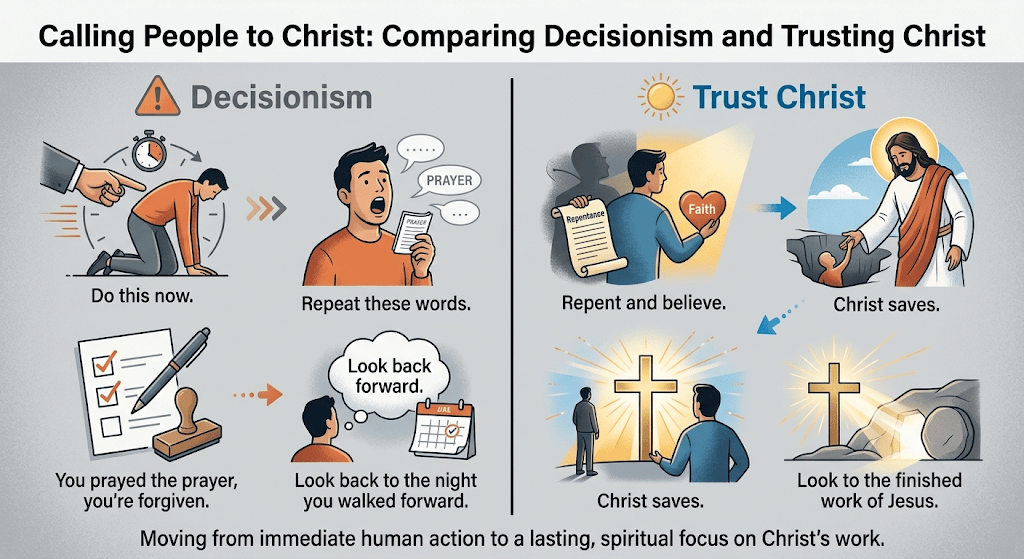
- Verbal Pronouncement: Announcing to the crowd: “You prayed that prayer, you’re forgiven.”
This sequence confuses emotional reaction with spiritual regeneration. The New Testament nowhere authorises an evangelist to declare a person forgiven simply because they repeated a series of words. Regeneration is the sovereign, supernatural work of the Holy Spirit (“Which were born, not of blood, nor of the will of the flesh, nor of the will of man, but of God” – John 1:13).
10. Decisional Regeneration and the Danger of False Assurance
“Decisional Regeneration” deemphasises original sin and human depravity, operating on the assumption that a sinner can be regenerated by making an immediate, conscious decision to accept Jesus via a formulaic prayer.
When an evangelist tells thousands, “You prayed that prayer; you’re forgiven,” he risks granting false assurance. Individuals who remain entirely unregenerate leave the arena believing their eternal destiny is secured because they walked an aisle or signed a card. They look back to a momentary action rather than looking in the present tense to the finished work of Jesus Christ and demonstrating the transforming fruit of the Holy Spirit (Matthew 7:16, 21; 2 Corinthians 13:5).
11. Billy Graham, Universalism, and the Ecumenical Compromise
Decisional regeneration has historically functioned as a primary engine for broad ecumenism. Because the Sinner’s Prayer reduces the Gospel to a generic, minimal decision, it allows fundamental doctrinal distinctions, such as those drawn by the Protestant Reformation, to be ignored.
The BGEA’s historical record under Billy Graham demonstrated a consistent pattern of ecumenical compromise and theological blurring:
- Ecumenical Alignment: Billy Graham routinely partnered with Roman Catholic dioceses and liberal Protestant bodies (such as the National Council of Churches), turning decision cards over to sacramental and non-evangelical churches. He remarked: “When I hear the Pope plead, ‘Come to Christ…’ he sounds like me when I invite people at the end of my services to come forward…”
- Inclusivism and Universalism: In his recorded 1997 interview with Robert Schuller, Billy Graham explicitly affirmed inclusivism:“He’s [God] calling people out of the world for His name, whether they come from the Muslim world, or the Buddhist world, or the Christian world or the non-believing world, they are members of the Body of Christ… They may not even know the name of Jesus but they know in their hearts that they need something… and I think that they are saved, and that they’re going to be with us in heaven.”
When evangelistic methodology focuses on counting “decisions” rather than upholding precise biblical doctrine, the Gospel itself becomes diluted. Roman Catholics or adherents of other traditions can repeat a generic sinner’s prayer without ever being confronted with their need to abandon sacramental works-righteousness or false dogmas.
12. Political Christianity vs. The Kingdom of God
Franklin Graham is heavily aligned with partisan political movements and cultural warfare. While Christians maintain civic responsibilities, fusing the Gospel of Jesus Christ with political power or national identity damages the witness of the church.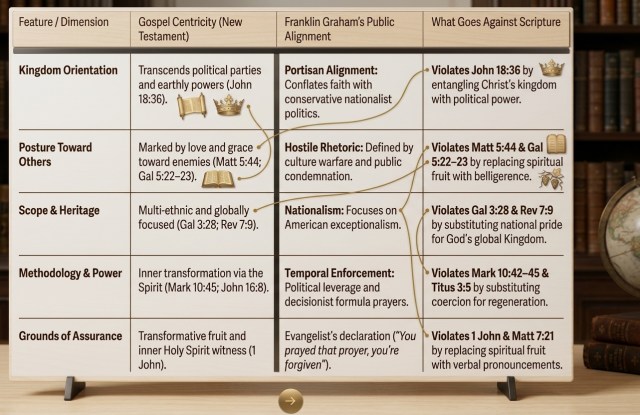
13. Calling People to Christ vs. Calling People to a Decision
There is a profound distinction between calling sinners to trust in the person and work of Jesus Christ and urging them to perform a decisional ritual.
14. A Word of Pastoral Balance to Hearers in Manchester
This analysis is not written to claim that every person who responded at the Manchester crusade is unsaved. God in His sovereign grace can save sinners in an arena, through imperfect preaching, and despite defective methodologies.
However, God’s sovereignty does not justify defective methodology, nor does it validate pronouncing people forgiven based on a repeated prayer.
If you responded in Manchester, do not rest your hope upon the fact that you walked an aisle, signed a card, or repeated Franklin Graham’s prayer. Look directly to Jesus Christ. Repent of your sins. Rely solely upon His substitutionary death and bodily resurrection. Search the Scriptures daily, join a biblically sound church, and examine your life for the real fruit of regeneration.
Conclusion: We Must Test the Method, Not Worship the Man
Franklin Graham is a prominent international figure. That prominence brings greater responsibility to handle the Word of God accurately, not immunity from biblical criticism.
UK Apologetics Library rejects:
- The idea that numerical attendance or crowds validate evangelistic methodology.
- The assumption that an altar call is equivalent to biblical conversion.
- The claim that repeating a prayer produces automatic regeneration.
- The authority of an evangelist to declare an individual forgiven based on a formula.
- The compromise of core Gospel doctrines for the sake of visible ecumenical unity.
The final authority is not Franklin Graham, Billy Graham, the BGEA, or an arena crusade. The final authority is the Word of God.
“Not every one that saith unto me, Lord, Lord, shall enter into the kingdom of heaven.” — Matthew 7:21
“Examine yourselves, whether ye be in the faith.” — 2 Corinthians 13:5
“Prove all things; hold fast that which is good.” — 1 Thessalonians 5:21
Test the message. Test the method. Test the theology. Test the fruit. And above all, test everything by Scripture.
Sources and Primary Documentation
- Billy Graham Evangelistic Association, A Firm Foundation in Manchester, reporting on the 3 October 2026 Manchester event.
- Billy Graham Evangelistic Association, God Loves You Tour — Manchester, event documentation.
- Billy Graham Evangelistic Association, Praying for Revival in Manchester, September 2026.
- Billy Graham Evangelistic Association, 20 Million Indicated Decisions for Christ Across the Globe.
- Billy Graham Evangelistic Association, Internet Evangelism statistics and follow-up information.
- Billy Graham, 1962 press conference/interview concerning the permanence of decisions and the distinction between an evangelist and God as the one who converts.
- Billy Graham & Robert Schuller, Television Interview transcript on Inclusivism/Universalism, Christian News, Oct. 20, 1997.
- Charles G. Finney, Memoirs of Rev. Charles G. Finney, New York: A.S. Barnes & Co., 1876.
- Antoine Guillaumont, Une inscription copte sur la prière de Jésus, Aux origines du monachisme chrétien, Abbaye de Bellefontaine, 1979.
- David Cloud, Quick Prayerism, Way of Life Literature.
- Office for National Statistics, Census 2021 — Manchester religious identity statistics.
- Manchester City Council, Census 2021 identity and religion statistics.
- UK Apologetics Library, Testing Revivalist Methodology against Sola Scriptura (ukapologeticslibrary.com).
- The Holy Bible — particularly Luke 18:9–14; John 1:12–13; John 3:3–8; John 16:8; Acts 2:21–38; Acts 17:11; Acts 22:16; Romans 3:19–26; Romans 10:9–10; 2 Corinthians 4:2; 2 Corinthians 5:17–21; 2 Corinthians 11:4; 2 Corinthians 13:5; Galatians 1:6–9; 2 Timothy 4:1–4; Titus 3:5; 1 Thessalonians 5:21; Revelation 3:14–22.
Summary: Franklin Graham God Loves You Tour 2026 Manchester Details
Whether you are planning to attend or looking for Franklin Graham UK tour dates, here is a quick summary of the Manchester event:
- Event: Franklin Graham God Loves You Tour UK
- Location: Co-op Live Arena, Manchester, UK
- Date & Time: Saturday, 3 October 2026 at 6:00 PM
- Tickets: Free admission (no paid tickets required)
Frequently Asked Questions
Are tickets required for the Franklin Graham Manchester 2026 event?
No, admission is completely free and open to everyone on a first-come, first-served basis. You do not need to buy tickets to enter.
Where can I find updates on Franklin Graham Tour dates?
For official announcements, venue access, and group bus registrations across the UK, visit the official Billy Graham Evangelistic Association UK website.
Views: 0
Discover more from UK Apologetics Library
Subscribe to get the latest posts sent to your email.
You must be logged in to post a comment.