


The Contagion of Compromise: A Theological Refutation of Franklin Graham’s Manchester God Loves You Tour and the BGEA Assimilation Strategy
1. Introduction: The Legacy of Mass Evangelism and Doctrinal Pragmatism
On October 3, 2026, the Co-Op Live arena in Manchester hosts Franklin Graham’s God Loves You Tour. Framed as a crucial beacon of hope for a spiritually secularised United Kingdom, the event promises high-calibre musical performances from Dove- and Grammy Award-winning artists Charity Gayle, Michael W. Smith, and Faith Child, and will be capped by an evangelistic message from Franklin Graham.
Behind the sleek production values, stadium lighting, and multi-week “Discovery Groups” assimilation program lies a deep historical and theological continuity. As documented by fundamental critiques such as those preserved in the UK Apologetics Library archives and independent historical research by writers like David Cloud (Way of Life Literature) cited strictly for historical and factual documentation with no endorsement implied, the Billy Graham Evangelistic Association (BGEA) has long relied on a methodology that elevates visible numerical output over uncompromised doctrinal truth.
To evaluate the God Loves You Tour biblically is not to question whether individuals hear snippets of truth, but whether the entire framework its broad ecumenical machinery, its decisionist theology, and its structural compromise with apostate institutions honours the holy standards of Scripture. The verdict of God’s Word is clear: an outreach built on unholy alliances, diluted warnings, and compromised fellowship cannot be called a biblical revival. It is a work of theological deception.
2. Exposing the Musical Pipeline: Charity Gayle, Emotionalism, and the Vatican’s “Spiritual Ecumenism”
A critical element of the BGEA campaign machinery relies on atmospheric conditioning through contemporary worship music to prepare the crowd emotionally. To understand how emotionalism bridges the gap between Protestant arenas and apostate systems, one must examine the ministry and music of lead performer Charity Gayle.
1. The Strategy of “Spiritual Ecumenism”
1. Unitatis Redintegratio (Second Vatican Council, 1964)
The Roman Catholic Church’s official ecumenical posture explicitly promotes what Rome terms “spiritual ecumenism” the use of shared spiritual experiences, prayer, and worship to cultivate a common “feeling” of unity that transcends doctrinal definitions.
Contemporary worship music that prioritises subjective, emotional experiences over objective, expository truth serves as the primary engine for this “spiritual ecumenism”. Because emotionalism bypasses doctrinal discernment, artists’ discographies slip seamlessly across denominational lines, moving from Pentecostal and non-denominational stages directly into Roman Catholic settings.
The foundational Vatican document that establishes and defines “spiritual ecumenism” as the core driving force of Catholic ecumenical efforts is Unitatis Redintegratio (Decree on Ecumenism), promulgated by Pope Paul VI and the Second Vatican Council on November 21, 1964.
Key Vatican Texts Defining “Spiritual Ecumenism”
In Chapter II, Section 8, the document formally defines “spiritual ecumenism” and establishes shared prayer and interior spiritual life as the essential engine for Christian unity:
Chapter II, Section 8:
“This change of heart and holiness of life, along with public and private prayer for the unity of Christians, should be regarded as the soul of the whole ecumenical movement, and merits the name, ‘spiritual ecumenism.’“
On Shared Liturgical & Spiritual Elements (Section 3 & 23):The document notes that non-Catholic traditions share genuine spiritual and liturgical actions that foster real, albeit incomplete, communion:“Our separated brethren also carry out many liturgical actions of the Christian religion… these most certainly can truly engender a life of grace in ways that vary according to the condition of each person and must be held capable of giving access to the communion of salvation.”
On Common Worship & Shared Spiritual Experience (Section 8):The decree explicitly promotes common prayer and joint spiritual gatherings as a means to express shared Christian bonds:“In certain special circumstances, such as the prescribed prayers ‘for unity,’ and during ecumenical gatherings, it is allowable, indeed desirable that Catholics should join in prayer with their separated brethren. Such prayers in common are certainly an effective means of obtaining the grace of unity…”
2. Directory for the Application of Principles and Norms on Ecumenism (Pontifical Council for Promoting Christian Unity, 1993)
Promulgated under Pope John Paul II, this document operationalizes the principles of Unitatis Redintegratio into concrete practices, explicitly encouraging Catholics to share in non-Catholic spiritual heritage, music, and prayer:
- Sharing in Spiritual Activities (Section 108):“Christians may be encouraged to share in spiritual activities and resources, i.e., to share that spiritual heritage they have in common in a manner and to a degree appropriate to their present divided state.”
- Common Prayer and Liturgical Participation (Section 118): “In liturgical celebrations taking place in other Churches and ecclesial Communities, Catholics are encouraged to take part in the psalms, responses, hymns and common actions of the Church in which they are guests.”
3. Ut Unum Sint (“That They May Be One” – Encyclical of Pope John Paul II, 1995)
Pope John Paul II reinforced this concept in his landmark 1995 papal encyclical, calling prayer and common worship the primary path toward overcoming doctrinal divisions:
- Section 21:“In the ecumenical movement, prayer is paramount… If Christians, despite their divisions, can grow ever more united in common prayer around Christ, they will grow in the awareness of how little divides them in comparison to what unites them.”
- Section 28:“Along the ecumenical path toward unity, pride of place certainly belongs to common prayer, to the prayerful gathering of those who come together as brothers and sisters in order to express their shared faith in Jesus…”
- Unitatis Redintegratio (Decree on Ecumenism – Second Vatican Council, 1964)See Chapter II, Section 8 specifically for the official definition of “spiritual ecumenism” and guidelines on common prayer.
- Directory for the Application of Principles and Norms on Ecumenism (Pontifical Council for Promoting Christian Unity, 1993)See Chapter III (Sections 102–121) regarding shared spiritual activities, music, and joint worship.
- Ut Unum Sint (On Commitment to Ecumenism – Encyclical of Pope John Paul II, 1995) See Chapter I, Section 21 and Section 28 on the centrality of common prayer in bridging doctrinal divisions.
2. Analysis of Charity Gayle’s Ecumenical Penetration
(The following analysis documents the usage and reception of Charity Gayle’s music across ecumenical spheres; compiled from independent research and public domain documentation):
Charity Gayle’s powerful voice recently earned her a Dove Award. She is passionate about sharing the Gospel and praising God through music. With each performance, her faith and love for the Lord is strengthened.
While she does not frequently headline or perform specifically for Roman Catholic liturgical events or explicitly branded “Catholic concerts,” her music has thoroughly permeated the Catholic Charismatic Renewal (CCR) and Catholic youth ministries.
Music Adopted by Catholic Parishes: Rather than performing at Catholic-specific arenas, her primary bridge into the Catholic Church is the universal adoption of her discography. Her massive hits are heavily utilized in several Catholic spheres:
- The Catholic Charismatic Renewal: This global movement within the Catholic Church places a heavy emphasis on Holy Spirit-led praise and worship. Songs like “I Speak Jesus” and “Throne Room Song” are staple anthems at modern Catholic charismatic conferences, healing rallies, and prayer groups.
- Catholic Youth Ministries: Modern Catholic youth rallies and Eucharistic Adoration events frequently utilize contemporary worship music to engage younger audiences.
- Theological Compatibility: Songs like “Thank You Jesus for the Blood” focus heavily on redemption, the sacrifice of Christ, and the power of the Eucharist/the Blood themes that line up seamlessly with core Catholic theology regarding the Mass and Christ’s sacrifice.
Broad Kingdom Booking Policy: Gayle’s booking and tour strategy operates on a broad “Kingdom work” model rather than isolating by denomination. When she or her ministry booking team coordinates events, they explicitly state openness to community and multi-church events. If a multi-church or citywide worship event includes Roman Catholic parishes working alongside Protestant churches, she will readily minister there. Her current tour schedule predominantly places her in major secular arenas, non-denominational event centers, and cross-denominational conferences (such as her work with Franklin Graham’s tours).
De-emphasising Labels and Catholic Musical Crossover: Charity Gayle’s understanding of worship provides a useful lens through which to consider the movement of contemporary charismatic music across denominational boundaries. In a 2023 interview, Gayle was asked about the labels applied to different forms of Christian music. She responded that, if anything were to be labelled, it should be the believer’s identity as a “disciple of Christ,” adding that while identifying musical style “has its place,” the deeper “heartbeat” is “the church” and “the church’s song.” She further described her own songwriting with her husband, Ryan Kennedy, as a “blended sound” arising from their different church and musical backgrounds.
This emphasis on a shared Christian identity rather than rigid musical boundaries provides a useful conceptual framework for understanding the circulation of contemporary worship music into Catholic devotional settings. As America reported in 2025, contemporary praise-and-worship music originated largely outside Catholicism but entered Catholic circles in part through ecumenical and Catholic charismatic events and groups. The magazine also notes that contemporary worship has become common in ministries serving teenage and young-adult Catholics, including Steubenville, Damascus and FOCUS, and describes a recurring Catholic pattern in which contemporary worship songs are incorporated into Eucharistic Adoration alongside traditional hymns.
The crossover can also be observed at the level of local Catholic practice. A first-person account published by The Catholic Telegraph describes a young Catholic leader’s experience at Damascus Catholic Mission Campus, where Mass, worship music and Adoration were deliberately combined. Following that experience, she organised a parish Holy Hour that paired contemporary musical praise with traditional Eucharistic Adoration, explicitly seeking to create an environment in which young people could encounter Catholic faith through a contemporary worship idiom.
Charity Gayle’s own music provides a concrete example of this broader process. A March 2025 Gospel newsletter from St. Michael Catholic Primary School and Nursery in Surrey, produced for children and families, explicitly recommends worshipping and praying through both traditional and contemporary music. It recommends “I Speak Jesus” by Charity Gayle as its contemporary option. Thus, Gayle’s music can be traced not simply as a product of the wider contemporary worship movement, but as a specific piece of repertoire that has entered a Catholic educational and devotional context in the United Kingdom, with some examples below.
- Catholic Youth Adoration & Ministry Framework:
- Praise and worship: the modern soundtrack of the U.S. Catholic Church: Demonstrates how Catholic youth ministries explicitly build Eucharistic Adoration structures around contemporary praise and worship music to engage teenagers and young adults.
- Worship Through Adoration and Music: A first-hand account from a Catholic youth leader detailing how contemporary praise-and-worship music is paired with traditional Eucharistic Adoration (via ministries like Damascus Catholic Campus) to create non-liturgical, highly engaging prayer environments for young Catholics.
- Praise and worship: the modern soundtrack of the U.S. Catholic Church: Demonstrates how Catholic youth ministries explicitly build Eucharistic Adoration structures around contemporary praise and worship music to engage teenagers and young adults.
- Charity Gayle’s Music & Crossover Impact:
- St. Michael Catholic Primary School & Nursery – Gospel Newsletter
- Context: In its weekly Gospel resource for Catholic parents and educators (integrated with Ten:Ten Resources, a widely used Catholic school curriculum provider in the UK), Charity Gayle’s song “I Speak Jesus” is featured as the recommended contemporary worship track to accompany the Gospel message.
2A. Broad “Kingdom Work” Booking Policy: Gayle’s own ministry booking policy explicitly presents her work in broad, non-denominational terms. Her official booking FAQ states, “We love to be a part of Kingdom work” and says that her team is “open to multi-church or community events.” This stated openness is reflected in her participation in large-scale Christian events that bring together churches and audiences across denominational boundaries. For example, her appearances with the Franklin Graham God Loves You Tour place her within evangelistic events involving large networks of local churches, while the 2026 Madrid Festival of Hope brought together more than 850 churches representing 15 denominations and featured Gayle as a worship artist. These examples demonstrate a ministry model oriented toward shared Christian worship rather than a strictly denominational audience.
2B. De-emphasising Genre and Denominational Labels: Gayle’s stated philosophy of worship provides a theological rationale for this cross-denominational reach. In a Worship Leader interview, she argued that although identifying musical style “has its place,” the more fundamental identity is that of the Christian as a disciple of Christ. She explained that, if anything should be labelled, it should be the fact that Christians are “disciples of Christ,” adding, “Our identity is in Him.” She also described the music she makes with her husband, Ryan Kennedy, as a blend arising from their different church and musical backgrounds. Her comments therefore suggest an approach in which musical style remains identifiable but is subordinate to a broader Christian identity.
This combination of a deliberately broad ministry policy and a stated preference for Christian identity over rigid musical labels helps explain the portability of Gayle’s repertoire across different Christian settings. That portability can then be examined empirically through documented Catholic uses of her music.
3. Discerning the Language of “I Speak Jesus”: Biblical and Theological Critique
The theological language of Charity Gayle’s “I Speak Jesus” has attracted criticism from some conservative Christian commentators, particularly over the repeated expression “I speak Jesus” and the song’s language concerning the power, healing and efficacy associated with Jesus’ name. One prominent critique comes from Christian writer Michelle Lesley, who addressed the song in a January 2025 article, “The Mailbag: ‘I Speak Jesus,’ Charity Gayle, and How to Vet Christian Music.” Lesley’s article should be understood as a theological critique rather than as an objective description of the song’s meaning; nevertheless, it provides a useful starting point for examining the song’s language against Scripture.
Lesley’s central objection is that Scripture does not instruct Christians to “speak Jesus over” people or circumstances as a distinct spiritual practice. She argues that biblical ministry is instead described through categories such as teaching, preaching, exhortation, rebuke, reproof, encouragement and comfort, and therefore questions whether the song’s terminology corresponds sufficiently closely to biblical categories. Her criticism is particularly directed at the phrase “I speak Jesus,” which she interprets as potentially implying that verbally invoking Jesus’ name produces a supernatural effect.
The lyrics themselves warrant examination because they repeatedly connect speaking Jesus’ name with particular spiritual outcomes. The song begins by describing the desire to “speak the name of Jesus” over “every heart and every mind,” and later associates this declaration with addiction breaking, hope, freedom, anxiety, depression and the breaking of “strongholds.” Its central refrain declares that Jesus’ name is associated with “power,” “healing” and “life.” The bridge extends this language to Jesus being proclaimed “over every enemy” and “for my family.”
The critical question, therefore, is not simply whether the word “Jesus” possesses power. Christian Scripture plainly attributes authority and salvation to Jesus’ name. The more precise question is what the song means by speaking the name of Jesus and what causal relationship it implies between verbal declaration and spiritual outcome.
There are at least two possible readings. On a charitable reading, “I speak Jesus” may function as poetic shorthand for proclaiming Christ, invoking his authority in prayer, declaring the gospel, or directing one’s attention toward Jesus in situations of fear, addiction and suffering. On a more critical reading, the repeated association between verbal declaration and outcomes such as breaking addictions, defeating strongholds, overcoming enemies and bringing healing could be understood as suggesting that verbal invocation itself exercises spiritual efficacy.
This distinction is important because the biblical phrase “the name of Jesus” ordinarily refers not merely to a sequence of spoken sounds but to Jesus’ person, authority and identity. Consequently, the theological question is whether the song’s language directs worshippers toward reliance upon Christ himself or encourages them to regard the verbal declaration of his name as a spiritual mechanism.
Lesley’s critique is strongest when framed as a question of biblical terminology and implied theology rather than as proof that the song is literally practicing magic or witchcraft. Her article makes those stronger accusations, including describing the language as “mystic” and comparing it to incantation. Those are her theological judgments and should therefore be presented as such rather than as established facts.
A responsible discernment process should consequently examine the lyrics without the accompanying musical atmosphere, compare their claims with Scripture in context, and ask what a worshipper is actually being encouraged to believe and do. The question is not merely whether the song mentions Jesus frequently, but whether its language accurately represents biblical teaching about prayer, the authority of Christ’s name, healing, spiritual warfare, human agency and God’s sovereignty.
Ref:https://michellelesley.com/2025/01/07/the-mailbag-i-speak-jesus-charity-gayle-and-how-to-vet-christian-music/
4. The Ecumenical Legacy of Contemporary Christian Music: Citing Michael W. Smith mentioned at the Manchester Tour and CCM Compromise
A second featured artist on the Manchester line-up is three-time Grammy-winning singer Michael W. Smith, who is highlighted by the BGEA as a longtime partner of Billy and Franklin Graham. However, when examined through the lens of historical discernment, Smith’s career represents a prime example of Contemporary Christian Music functioning as an ecumenical bridge toward Rome and broader religious compromise.
(The following documentation is referenced directly from David Cloud’s documented research article, “Contemporary Christian Music and Rome”, published at Way of Life Literature; cited for historical and factual documentation, with no endorsement implied):
Documented Ecumenical Alliances of Michael W. Smith and CCM
As documented in Contemporary Christian Music and Rome:
- Ecumenical Compromise in CCM: Contemporary Christian Music serves as a primary vehicle for the end-times ecumenical movement, building bridges across apostate Protestantism and Roman Catholicism. As observer Richard Peck observed in Making Musical Choices: “CCM is proud of its ecumenical and charismatic spirit. This ecumenism extends open arms toward apostate Protestant denominations and the Roman Catholic Church.”
Michael W. Smith’s Roman Catholic Venues & Collaborations:
- Michael W. Smith performed at the Roman Catholic-sponsored World Youth Day in Denver, Colorado, in 1993, an event attended by Pope John Paul II and hundreds of thousands of Catholic young people. A secondary source specifically reports Smith’s performance at the event. Source: Directory of Contemporary Worship Musicians
- Smith joined Kathy Troccoli and guitarist Billy Sprague at a concert in Tampa, Florida, in November 1985. The event is documented in the Directory of Contemporary Worship Musicians, which cites the St. Petersburg Times, Religious Section, November 9, 1985, p. 3, as its source. Source: Directory of Contemporary Worship Musicians
- Billy Sprague’s own biography independently confirms that he toured with Michael W. Smith and that Kathy Troccoli recorded his songs. Billy Sprague – official biography: Michael W. Smith authored the foreword to Brennan Manning’s The Ragamuffin Gospel. Google Books’ bibliographic record explicitly lists “Foreword by Michael W. Smith.” Google Books – The Ragamuffin Gospel
- Brennan Manning’s book itself describes him as a former Franciscan priest. The Ragamuffin Gospel – book text/preview
- For the additional claims that Manning regularly offered Mass and promoted contemplative monastic spirituality, I would cite separate sources rather than treating those facts as established by the Smith foreword. Smith’s 1998 single “Live the Life” was described as being “inspired by the life of the Catholic St. Francis of Assisi.” The contemporary source is identified in the Directory of Contemporary Worship Musicians as Christian Music Online, “New Releases October 28, 1997.” Directory of Contemporary Worship Musicians – Smith entry and source citation
- The original Christian Music Online page appears to be offline, so this is currently a secondary citation of the contemporary source.In the fall of 2009, Michael W. Smith toured with Roman Catholic artist Matt Maher on the New Hallelujah World Tour. The 2009 tour announcement identifies Maher as one of Smith’s special guests, and Smith himself said he was excited to share the stage with him. 2009 New Hallelujah Tour announcement
- Smith’s official tour photographs also identify Matt Maher as part of the October 22, 2009 concert in Orlando. Michael W. Smith – A New Hallelujah Concert, October 22, 2009
- A contemporary 2009 report likewise lists Maher among the artists travelling with Smith. Louder Than The Music – October 6, 2009, Participation in Ecumenical Anthems: Michael W. Smith was among the Christian artists who participated in Kathy Troccoli’s “Love One Another,” a song associated with her 1997 Love & Mercy project. Contemporary Christian music records show “Love One Another” as a Michael W. Smith recording, and the Directory of Contemporary Worship Musicians describes the project as involving Troccoli and approximately 40 other CCM artists and as having an explicitly ecumenical theme focused on tearing down denominational divisions. Directory of Contemporary Worship Musicians – Love One Another documentation
Christian music chart archive – Love One Another
Case Study: Together 2016 and Papal Coalition-Building
A pivotal example of Michael W. Smith’s ongoing commitment to ecumenical platforms occurred at the Together 2016 rally held on July 16, 2016, at the National Mall in Washington, D.C. Documented in detail by news outlets such as Evangelical Focus in their report “Together 2016 celebrated ‘unity’ of Christians in evangelism”, the mass event brought together over 40 speakers and musicians spanning Protestant, Evangelical, and Roman Catholic traditions under a mandate for unified worship.
Reference Summary – Evangelical Focus (July 18, 2016):
“Together 2016 celebrated ‘unity’ of Christians in evangelism”
Ecumenical Gathering: Thousands gathered on the National Mall for an event designed to “bring people from all backgrounds together for a day of unified worship and prayer.”
Controversial Papal Video Greeting: Event organizer Nick Hall traveled to Rome to meet Vatican officials, leading to a personal video address from Pope Francis played directly to the crowd. In his message, the Pope urged millennial attendees to follow Jesus, stating: “He is the One who planted the seeds of restlessness in your heart. Give it a try! You have nothing to lose!”
Promoting Roman Catholic Unity: Roman Catholic worship artist Matt Maher addressed the audience alongside Lecrae, Francis Chan, and others, declaring: “If we’re singing the same songs together, then we can’t yell at each other,” explicitly reiterating his calling toward the unification of Protestants and Catholics.
Michael W. Smith’s Perspective: Speaking to media regarding how Together 2016 differed from past revivals, Michael W. Smith defended the unified gathering, stating: “What sets this one apart is there seems to be an urgency like never before. I have never seen our nation in this state… You can probably go back to Billy Graham and he would probably say the same thing.”
A pivotal example of Michael W. Smith’s participation in ecumenical Christian platforms occurred at the Together 2016 rally, held on July 16, 2016, at the National Mall in Washington, D.C. The event was organized by PULSE and brought together more than 40 Christian speakers and musicians from different backgrounds for a day of unified prayer and worship. Michael W. Smith was among the featured musicians.
Reference: Evangelical Focus – “Together 2016 celebrated ‘unity’ of Christians in evangelism”
Additional contemporary source: Christian Post – Michael W. Smith at Together 2016
Roman Catholic participation: The event included a video address from Pope Francis. PULSE’s June 2016 announcement described the event as featuring “40+ well-known speakers, recording artists, authors and leaders from various backgrounds” for “a day of unified prayer and worship,” and specifically listed Michael W. Smith and Matt Maher among the participants.
PULSE/PR Newswire – Pope Francis to Address Americans at Together 2016
Pope Francis’s video message: Pope Francis addressed the millennials attending the event through a video greeting. He spoke about the “restlessness” in their hearts and encouraged them to pursue Jesus, saying that Jesus is the one who planted those seeds of restlessness and inviting them to “give it a try.”
Christian Post – Pope Francis’s Together 2016 message
Matt Maher and Christian unity: Roman Catholic musician Matt Maher also appeared at Together 2016. Evangelical Focus reported that Maher told the crowd, “If we’re singing the same songs together, then we can’t yell at each other,” and described him as having previously spoken of a calling to work toward Christian unity.
Evangelical Focus – Together 2016
Michael W. Smith’s comments: Smith was asked how Together 2016 differed from previous revival events. He responded: “What sets this one apart is there seems to be an urgency like never before. I have never seen our nation in this state,” comparing the moment to the kind of national crisis Billy Graham had addressed.
Christian Post – Michael W. Smith at Together 2016
Smith’s participation matters because he appeared on a platform that explicitly promoted unified Christian worship, included Roman Catholic musician Matt Maher, and featured a personal video address from Pope Francis. His own comments portrayed the gathering positively as an unusually urgent moment for American Christianity.
That gives you a much stronger evidentiary chain: Smith’s presence leads explicitly to unified worship with Catholic participants, leads to papal participation, and leads to Smith’s positive comments about the event.
Also, the contemporary Washington Post report is useful as an independent check: it described Together 2016 as a gathering of thousands of evangelicals and noted that Pope Francis provided a greeting, while also noting that some evangelical leaders had concerns about the Catholic pope’s involvement.
Washington Post – “’God break racism!’ Evangelicals on D.C. Mall pray for hope and reconciliation”
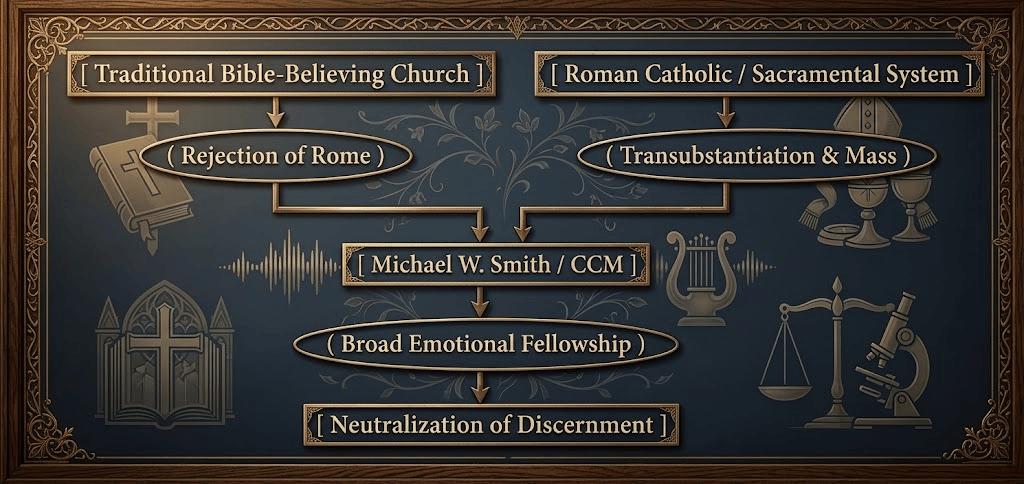
Exposing the Theological Pathology of Smith’s Alignment
Michael W. Smith’s career provides several documented examples of participation in ecumenical and Roman Catholic contexts. These include appearances alongside Catholic musicians such as Matt Maher, participation in events with Roman Catholic representation, and involvement in projects that explicitly promote Christian unity across denominational boundaries. His participation in the 2016 Together 2016 gathering is particularly significant: the event promoted unified Christian worship, featured Catholic musician Matt Maher, and included a video address from Pope Francis. Evangelical Focus – Together 2016
1. The Sola Fide Question.
From a confessional Protestant perspective, Smith’s participation in these ecumenical settings raises an important theological question concerning the relationship between Christian unity and doctrinal agreement. The Protestant doctrine of sola fide differs substantially from the Roman Catholic doctrine of justification defined at the Council of Trent. Trent’s canons explicitly rejected the proposition that justification is by faith alone in the Reformation sense. Council of Trent – Sixth Session, Canons on Justification
The historical evidence, however, establishes Smith’s participation in ecumenical settings, not necessarily that Smith personally rejected sola fide or consciously intended to obscure the distinction. That theological conclusion would require evidence from Smith’s own statements or doctrinal commitments.
2. The Role of Worship Atmosphere.
Smith’s music also raises a broader question about the role of contemporary worship in ecumenical settings. His highly accessible, arena-oriented worship repertoire has been used in large evangelistic and interdenominational gatherings. At Together 2016, for example, music and unified worship were deliberately employed to bring Christians from different backgrounds together, while the event simultaneously incorporated Catholic participation and a message from Pope Francis. PR Newswire – Pope Francis to Address Together 2016
Rather than asserting that such music “dulls the critical faculties,” which would require psychological or empirical evidence, a more defensible theological criticism is that the emotional and communal power of contemporary worship can potentially make denominational and doctrinal distinctions less prominent within an ecumenical gathering. Whether that constitutes a legitimate form of Christian unity or an unacceptable compromise depends upon one’s theological framework.
Michael W. Smith’s career illustrates how contemporary Christian music can function as a vehicle for ecumenical cooperation. His participation in events with Roman Catholic musicians and leaders shows that musical unity can cross significant denominational boundaries. From a confessional Protestant perspective, this raises the question of whether such musical and relational unity adequately preserves distinctions concerning justification, sacramental theology, and the nature of the gospel. The concern is not simply that Smith performs alongside Catholics, but that contemporary worship can create a shared devotional environment in which substantial doctrinal differences become less visible or less central to the experience of Christian fellowship.
5. Refutation of Secular and Broad-Church Defence: Examining the “Flawed Messenger” Argument
Regional Christian commentary provides examples of the reasoning used to defend cooperation with Franklin Graham and the Billy Graham Evangelistic Association (BGEA). In his article “Franklin Graham: Welcome to Vancouver!”, published by Church for Vancouver, Flyn Ritchie discusses Graham’s forthcoming Vancouver appearance and addresses concerns surrounding Graham’s political involvement and public controversies. Ritchie argues that Christians should distinguish between the flaws of a human instrument and God’s ability to use that instrument for his purposes. Church for Vancouver – “Franklin Graham: Welcome to Vancouver!”
The underlying principle can be summarized as follows: God may accomplish genuine spiritual good through imperfect or controversial human instruments. This principle has biblical precedent. Scripture records God accomplishing his purposes through people whose character or conduct was seriously compromised; consequently, the mere existence of flaws in a Christian leader does not, by itself, prove that every ministry associated with that person is illegitimate.
The more important question, therefore, is not simply whether God can use a flawed messenger, but whether Scripture permits Christians to participate in a particular ministry, partnership, or teaching platform when serious doctrinal concerns are present.
This distinction provides the basis for the following four biblical tests:
- The test of doctrinal truth – whether the message being proclaimed accords with the biblical gospel (Gal. 1:6–9).
- The test of separation from false teaching – whether Christians are commanded to distinguish themselves from teachers or movements that contradict apostolic doctrine (Rom. 16:17; 2 John 9–11).
- The test of spiritual discernment – whether believers are instructed to examine teachers and teachings rather than accepting ministry effectiveness as proof of divine approval (Acts 17:11; 1 John 4:1).
- The test of Christian fellowship – whether partnership creates an association that compromises rather than preserves biblical truth (2 Cor. 6:14–18).
This reframes the issue. The question is not whether God is sovereign enough to use a flawed person; Scripture clearly establishes that he is. The question is whether God’s ability to use an individual should be treated as biblical authorisation for Christians to endorse, partner with, or materially support that individual’s ministry. Those are different propositions and must be evaluated separately.
1. Conflating Personal Infirmity with Doctrinal Apostasy
Ritchie compares accepting Franklin Graham to his own personal conversion through a missionary family that was later discovered to be morally flawed. His argument illustrates the broader principle that God may use an imperfect human instrument to accomplish spiritual good. However, this reasoning does not by itself settle the question of whether a particular teacher, ministry, or ministry partnership is doctrinally sound.
The Biblical Refutation: Scripture acknowledges that all human messengers are imperfect vessels (2 Corinthians 4:7). However, Scripture also draws a fundamental distinction between a believer’s personal moral frailty and a teacher’s doctrinal corruption or participation in religious fellowship that compromises biblical truth. Paul was willing to tolerate those who preached Christ out of envy and rivalry because, despite their wrong motives, they still proclaimed the true Christ (Philippians 1:15–18). By contrast, Paul pronounces an anathema upon anyone, even an angel, who proclaims a gospel contrary to the one the apostles had received (Galatians 1:8–9).
The same principle applies to religious fellowship. Paul commands believers not to be unequally yoked with unbelievers and calls them to distinguish themselves from incompatible forms of religious partnership (2 Corinthians 6:14–17). Thus, the biblical question cannot simply be whether God is capable of using a flawed messenger. The question is whether the message being proclaimed and the fellowship being offered remain faithful to the gospel.
Consequently, compromise concerning Gospel truth cannot be dismissed merely as a “personal flaw.” Where the Gospel itself is compromised, Scripture treats the matter as a fundamental spiritual and doctrinal violation.
2. Pragmatic “Results” Over Scriptural Separation
The broad-church argument asserts that because BGEA events draw large crowds and produce professions of faith, local churches should set aside theological disagreements and unite behind the crusade machinery. The underlying assumption is that visible results provide sufficient evidence that the ministry should be supported, even where significant doctrinal disagreements remain.
The Biblical Refutation: Scripture does not establish numerical success, crowd size, or visible results as the final measure of ministerial faithfulness. Saul was confronted by Samuel after achieving what appeared to be a successful military outcome, yet Samuel declared, “To obey is better than sacrifice” (1 Samuel 15:22). The passage establishes the priority of obedience to God’s revealed commands over outward religious achievement.
The New Testament likewise commands believers to exercise doctrinal discernment rather than allowing apparent success to settle the question. Paul writes, “Now I beseech you, brethren, mark them which cause divisions and offences contrary to the doctrine which ye have learned; and avoid them” (Romans 16:17). The criterion is not how large the ministry is, how many people respond, or how impressive the visible results appear. The criterion is whether the teaching conforms to the apostolic doctrine.
This principle is particularly important when evaluating evangelistic campaigns. Professions of faith, large attendance figures, and reports of spiritual decisions may be encouraging, but none of these outcomes can independently establish that a ministry’s methods, theological partnerships, or doctrinal framework are biblically sound. Scripture requires the message and the ministry itself to be tested against the Word of God.
Therefore, if numerical success is used to justify setting aside biblical separation or doctrinal concerns, the argument reverses the biblical order. Scriptural obedience must govern the evaluation of ministry results, rather than ministry results being used to redefine what counts as scriptural obedience.
3. Broad Ecumenical Coalition-Building Validated as “City Unity”
Ritchie highlights the broad coalition of churches that can participate in BGEA evangelistic festivals, presenting cooperation across denominational and ecclesial boundaries as an expression of Christian unity. Such campaigns can bring together large numbers of churches and ministries that otherwise differ significantly in doctrine and ecclesial practice.
The Biblical Refutation: Scripture does command Christians to pursue genuine unity. However, biblical unity is not defined merely by institutional cooperation, shared events, or a common geographical location. It is grounded in the truth of the apostolic faith: “One Lord, one faith, one baptism” (Ephesians 4:5). Christian unity, therefore, cannot be separated from doctrinal faithfulness.
From a confessional Protestant perspective, this creates a serious theological problem when evangelical churches enter into formal religious cooperation with bodies whose doctrines concerning justification, the sacraments, baptism, or the authority of the Church differ fundamentally from historic Protestant teaching. In particular, Roman Catholic teaching concerning justification and sacramental theology cannot simply be treated as interchangeable with the Reformation understanding of salvation by grace through faith.
Paul’s warning in 2 Corinthians 6:14–17 provides an important principle for evaluating such partnerships: “What communion hath light with darkness?” and “Wherefore come out from among them, and be ye separate, saith the Lord.” The passage emphasises that there are circumstances in which religious fellowship and partnership become incompatible with faithfulness to God.
Consequently, geographical or organisational unity is not necessarily biblical unity. A coalition may successfully unite churches under one event while leaving unresolved and potentially obscuring the doctrinal differences that Scripture requires believers to take seriously. From a separatist Protestant perspective, cooperation that treats fundamental doctrinal distinctions as secondary risks replacing biblical unity in truth with an externally visible unity built around common activity.
The central question, therefore, is not whether churches can cooperate under the banner of “city unity,” but whether the proposed unity is unity in the truth of the Gospel or unity achieved by setting substantive doctrinal differences aside.
4. Reducing Doctrinal Truth to Political or Social Preference
Commentators like Ritchie reduce opposition to Graham down to his political statements, civic comments, or “polarizing” persona.
The Biblical Refutation: While Graham’s political entanglement and civic comments draw secular critique, the core biblical objection to the BGEA is not political it is theological. The primary danger of the BGEA is its systematic dilution of the Gospel, its use of emotional decisionism, and its practice of funnelling new professing believers directly back into apostate and sacramental church systems.
6. Refutation of the Encyclopedia Profile: Testing the BGEA Legacy by Scripture
Biographical profiles such as the Encyclopedia.com entry on William Franklin Graham Jr. often emphasise the BGEA’s enormous crowds, evangelistic numbers, political influence, and broad denominational cooperation. Yet Scripture must evaluate these achievements. From a separatist Protestant perspective, the central concern is not the size or influence of the ministry, but whether its Gospel message, evangelistic methods, and ecclesiastical partnerships conform to biblical doctrine and separation. Where numerical success is accompanied by doctrinal ambiguity or cooperation with churches holding materially different teachings on salvation, Scripture not popularity or results must determine whether the ministry is faithful.
1. The Myth of “Simple” Gospel Preaching vs. Scriptural Repentance
The profile summarises Billy Graham’s core message as simply: “Choose Christ as I did. Mankind is sinful, but through Christ those sins are forgiven, and people can live in peace… a message of love and hope.”
The Biblical Refutation: Scriptural conversion is not merely a psychological “choice” or an invitation to personal “peace.” True biblical preaching begins with the terrifying reality of divine wrath, total human depravity, and the demand for radical repentance (metanoia) and surrender to the Lordship of Christ (Luke 13:3; Mark 1:15; Acts 17:30). By reducing the Gospel to an easy-believism sales pitch, “Choose Christ for peace”, the BGEA removes the offence of the Cross, giving hearers false comfort without confronting them with the holiness of God.
2. Broad Ecumenical Compromise Celebrated as Success
The profile explicitly praises Graham’s pragmatism: “Although basically a fundamentalist in his theology… he always sought and obtained a broad base of ecumenical support for his evangelistic campaigns.”
The Biblical Refutation: Scripture strictly forbids seeking “a broad base of ecumenical support” with those who teach another gospel. Paul writes under divine inspiration: “But though we, or an angel from heaven, preach any other gospel unto you than that which we have preached unto you, let him be accursed” (Galatians 1:8). Partnering with Roman Catholicism and liberal Protestantism to build mass crusade coalitions directly corrupts the Gospel by treating apostate systems as valid partners in Christ’s work (2 Corinthians 6:14–17).
3. Worldly Recognition and Unholy Honors
The profile highlights Graham’s accolades, including the Franciscan International Award (1972) and the Templeton Prize for Progress in Religion (1982), as well as meetings with political monarchs, presidents, and popes.
The Biblical Refutation: Jesus explicitly warns: “Woe unto you, when all men shall speak well of you! for so did their fathers to the false prophets” (Luke 6:26). Accepting awards from Roman Catholic monastic orders (Franciscans) and syncretic religious organizations (Templeton Foundation) demonstrates a total abandonment of biblical separation from error (2 John 1:10–11).
4. Syncretism and Universalist Tendencies
The article records Graham’s conviction that “the whole world, regardless of culture and religious tradition, is searching for something spiritual.”
The Biblical Refutation: This premise directly contradicts Romans 3:11 (“there is none that seeketh after God”). Unregenerate mankind is not genuinely seeking the true God; they construct idolatrous traditions to suppress the truth in unrighteousness (Romans 1:18–23). To affirm people in their generic “spiritual search” without calling them out of false religions is to leave them under judgment.
7. Refutation of BGEA Campaign Documentation: The Vancouver Festival of Hope Blueprint
Archived documentation from the Billy Graham Evangelistic Association of Canada (“What is the Festival of Hope?” Vancouver, March 2017, archived via the Internet Archive Wayback Machine) explicitly outlines the core strategy and promotional rhetoric used across BGEA campaigns. Analysing this primary source document exposes four fundamental theological corruptions embedded in the BGEA operational strategy:
1. Validating Generic “Spirituality” Over Scriptural Depravity
The BGEA document asserts:
“Canadians today know less about Jesus than at any other time in Canadian history. Yet, research reveals many people are very interested in spirituality.”
The Biblical Refutation: The BGEA bases its outreach strategy on secular market research showing interest in generic “spirituality”. However, Scripture teaches that unregenerate man’s desire for “spirituality” without the God of the Bible is idolatry (Romans 1:21–25). Unconverted people do not seek the Holy God of Scripture; they seek a spiritual experience that tolerates their sin. To appeal to man’s subjective “interest in spirituality” rather than confronting his objective guilt before a holy God corrupts the Gospel from its very start.
2. Pragmatic “Multi-Phase” Campaign Machine vs. Local Church Authority
The document advertises the campaign as a corporate, multi-stage funnel:
“The Festival of Hope is a multi-phase initiative spread over several months that includes prayer, training, Community Action Projects, and many opportunities for evangelism… Our Festival of Hope ministry is a partnership with local churches. It unites Christians across large metropolitan areas…”
The Biblical Refutation: Scripture appoints the autonomous local church, governed by qualified, elder-led shepherds, as the pillar and ground of the truth (1 Timothy 3:15). The BGEA replaces biblical church order with a centralised, multi-stage corporate machine that “unites” local churches across a metropolitan area regardless of their doctrinal purity. Uniting true churches with apostate bodies under the banner of a multi-phase event directly disobeys 2 Corinthians 6:14.
3. Entertainment-Driven Revival and Atmospheric Conditioning
The BGEA document promotes the arena event with the blueprint:
“Popular music mixed with Gospel presentations from Franklin Graham reach people of all ages.”
The Biblical Refutation: The Apostle Paul specifically rejected worldly entertainment and rhetorical craftiness when preaching the Gospel: “And I, brethren, when I came to you, came not with excellency of speech or of wisdom, declaring unto you the testimony of God… And my speech and my preaching was not with enticing words of man’s wisdom, but in demonstration of the Spirit and of power” (1 Corinthians 2:1, 4). Mixing worldly, pop-style entertainment with brief Gospel speeches relies on emotional conditioning rather than the convicting power of the Holy Spirit through the unadulterated preaching of the Word.
4. Standardized Rapid-Training Programs (“Christian Life and Witness Course” / “FM419”)
The BGEA outline highlights its quick-training model:
“TRAIN: Learn how to share your faith with others through our Christian Life and Witness Course for adults and our high-energy youth training event, FM419. Church leaders, learn how to disciple new believers at our Follow-up Seminar.”
The Biblical Refutation: Discipleship and training in sound doctrine cannot be mass-produced in a brief seminar or a high-energy youth weekend. True biblical equipping occurs through steady, local church instruction and pastoral care (2 Timothy 2:2; Titus 2:1–8). Replacing patient, local church discipling with high-speed BGEA seminars produces superficial workers who are ill-equipped to contend for the faith once delivered unto the saints (Jude 1:3).
8. Ecumenical Compromise, False Inclusivity, and Unholy Alliances (2 Corinthians 6:14–17)
The BGEA Blueprint: From Billy to Franklin Graham
The UK Apologetics Library archive carefully documents how the BGEA pioneered pragmatic ecumenism in mass evangelism. Beginning with Billy Graham’s 1950s campaigns, where Decision Cards were routinely handed over to liberal Protestant and Roman Catholic churches, the BGEA established a precedent: unity in numbers at the expense of separation from error.
Far from departing from this trajectory, Franklin Graham has actively expanded it. As recorded in public record and historical documentation (including David Cloud’s analysis Franklin Graham’s Unscriptural Ecumenism at Way of Life Literature, referenced solely for its documented press citations):
- Direct Endorsement of Compromise: Franklin Graham openly defended his father’s historic alliance with the Roman Catholic Church, stating to The Indianapolis Star (June 3, 1999) that partnering with Catholicism and all other denominations “was one of the smartest things his father ever did,” noting that early Catholic backing in Boston “set the example: ‘If Billy Graham is willing to work with everybody, then maybe we should too.'”
- A Global Pattern of Compromised Festivals: Across decades of BGEA campaigns such as Adelaide, Australia (1998), Lubbock, Texas (2000), Halifax (2004), Corpus Christi (2005), Baltimore and Winnipeg (2006), and Warsaw, Poland (2014), the BGEA actively integrated Roman Catholic bishops, archdioceses, and priests directly onto festival executive committees, utilising Catholic counsellors and delivering decision follow-up cards straight into Catholic parishes.
- Public Affirmation of Papal Authority: Franklin Graham praised Pope John Paul II on national television networks (NBC, Fox News), asserting that evangelicals and the Pope agreed on the “fundamentals” of the faith, while overlooking Rome’s formal denial of justification by faith alone (Sola Fide). Furthermore, Franklin officially attended the Vatican enthronement of Pope Benedict XVI on behalf of the Graham family.

Exposing the Manchester Machine
The advertisement for the Manchester God Loves You Tour (at Billy Graham Evangelistic Association UK Events) explicitly boasts that “thousands of people have found new life… with help from hundreds of congregations.” This “broad tent” approach requires local organizational committees to incorporate diverse, spiritually contradictory denominations:
- Roman Catholic Parishes: Institutions that explicitly teach a sacramental, works-based gospel (baptismal regeneration, the sacrifice of the Mass, the veneration of Mary, and purgatory), which Scripture explicitly pronounces under anathema (Galatians 1:8–9).
- Theologically Liberal & Modernist Bodies: Denominations that reject the absolute inerrancy of Holy Scripture, deny the exclusivity of Christ, and celebrate unbiblical morality.
To gather seekers and new professing believers, run them through local “Discovery Groups,” and then funnel them directly into churches that deny the fundamental truths of the Gospel is a direct violation of Apostolic commands:
“Be ye not unequally yoked together with unbelievers: for what fellowship hath righteousness with unrighteousness? and what communion hath light with darkness?… Wherefore come out from among them, and be ye separate, saith the Lord.”
– 2 Corinthians 6:14, 17
“Whosoever transgresseth, and abideth not in the doctrine of Christ, hath not God. He that abideth in the doctrine of Christ, he hath both the Father and the Son. If there come any unto you, and bring not this doctrine, receive him not into your house, neither bid him God speed: For he that biddeth him God speed is partaker of his evil deeds.”
– 2 John 1:9–11
9. The Flaws of Mass Decisionism and “Discovery Group” Assimilation
The Anatomy of the Campaign Pipeline
- Atmospheric Conditioning (Setting the Emotional Stage): High-energy urban gospel and rap by Faith Child, worship anthems by Charity Gayle, and hit songs by Michael W. Smith build a heightened emotional environment across the stadium crowd.
- The Streamlined Appeal: A simplified message emphasizing God’s love is presented, largely devoid of the terrifying reality of God’s holy wrath, total human depravity, or the steep cost of true discipleship.
- Instant Assurance at the Altar Call: Attendees who walk forward or pray along are immediately informed they are now born-again children of God, bypassing the biblical requirement to test spirits and observe sanctifying fruit over time (Matthew 7:15–20; 2 Corinthians 13:5).
- Discovery Group Assimilation: Respondents are funnelled through standardised multi-week “Discovery Groups” and routed directly to participating area churches regardless of whether those churches teach a sacramental, works-based, or liberal theology.
The Pathology of Decisionism
A central focus of both the UK Apologetics Library archive and historical critiques is the danger of “decisionism.” Decisionism is the unscriptural premise that a physical movement (walking an aisle), a verbal repetition (a sinner’s prayer), or a signed card equates to immediate, guaranteed spiritual regeneration.
The “Discovery Groups” Model: A Corporate Funnel
The BGEA advertises its one-night training sessions to equip locals to create “small, intentional discipleship groups” using Matthew 28:19 (“Go therefore and make disciples”).
However, biblical discipleship is the solemn responsibility of the local church under the care of qualified, elder-led shepherd-teachers (1 Timothy 3; Titus 1; Acts 20:28)—not a standardized, rapid-response program managed by a crusade committee. When a crusade funnel directs an emotionally moved respondent into a multi-week “Discovery Group” hosted by an ecumenically compromised church, it offers a superficial substitute for biblical conversion. It creates nominal professing Christians who are given false assurance without ever experiencing the radical, heart-cleansing work of the Holy Spirit (Ezekiel 36:26).
10. Documented Reference Links & Web Directory
- Billy Graham Evangelistic Association UK — God Loves You Tour Manchester — Official event listing for the Co-Op Live arena campaign in Manchester, UK. Website:
[https://billygraham.org.uk/god-loves-you-tour-manchester/](https://billygraham.org.uk/god-loves-you-tour-manchester/) - Billy Graham Evangelistic Association (BGEA Official Portal) — Global site detailing crusade scheduling, promotional materials, and international ministry partnerships. Website:
[https://billygraham.org] - Evangelical Focus – “Together 2016 celebrated ‘unity’ of Christians in evangelism” – News report detailing the July 16, 2016 ecumenical event at the National Mall, featuring Pope Francis’s greeting and statements from Michael W. Smith. Website:
[https://evangelicalfocus.com/world/1797/together-2016-celebrated-unity-of-christians-in-sharing-jesus] - Michelle Lesley – “The Mailbag: ‘I Speak Jesus,’ Charity Gayle, and How to Vet Christian Music” — Critical theological analysis of the song “I Speak Jesus” and biblical discernment guidelines for worship music. Website:
[https://michellelesley.com/2025/01/07/the-mailbag-i-speak-jesus-charity-gayle-and-how-to-vet-christian-music/] - Way of Life Literature – Contemporary Christian Music and Rome (David Cloud) – Extensive research article citing the ecumenical ties and Catholic collaborations of CCM artists, including Michael W. Smith. Website:
[https://www.wayoflife.org/database/ccm_and_rome.html] - Church for Vancouver – Flyn Ritchie Article – Broad-church commentary defense titled “Franklin Graham: Welcome to Vancouver!” (Sept. 8, 2016). Website:
[https://churchforvancouver.ca/franklin-graham-welcome-to-vancouver/] - UK Apologetics Library – Archival repository analysing decisionism, ecumenical alliances, and mass crusade follow-up methods in the UK. Website:
[http://www.ukapologetics.net] - Way of Life Literature – David Cloud Archives – Historical repository providing press citations and analysis regarding BGEA ecumenism (cited for factual reference). Website:
[https://www.wayoflife.org] - BGEA Canada Festival of Hope Archival Document – Internet Archive Wayback Machine snapshot of BGEA campaign strategy document. Website: Wayback Machine Link – https://web.archive.org/web/20161013131709/https://www.billygraham.ca/what-we-do/evangelism-outreach/celebrations-festivals/festivals/vancouver/about/what-is-the-foh
11. Conclusion: The Call to Biblical Separation and Faithful Local Outreach
(Note: References to external writers, bloggers, or news outlets, including Evangelical Focus, Michelle Lesley, Flyn Ritchie, and David Cloud, are included strictly for factual citation of published articles, quoted commentary, and event documentation; inclusion does not constitute an overall endorsement of their broader platforms.
The God Loves You Tour at Co-Op Live Manchester presents a polished veneer of Christian zeal and musical excellence. Yet, when evaluated against Holy Scripture, its framework relies on emotionalism, unscriptural linguistic mantras (such as “I Speak Jesus”), and pragmatic “spiritual ecumenism” exemplified by artists like Charity Gayle and Michael W. Smith, which bridges sound churches with apostate systems.
True revival in Manchester will not come through stadium spectacles or emotional manipulation. It will come through faithful local churches preaching the whole counsel of God, calling sinners to genuine repentance, and standing firm in sound doctrine.
“Now I beseech you, brethren, mark them which cause divisions and offences contrary to the doctrine which ye have learned; and avoid them.”
— Romans 16:17
Views: 18
Discover more from UK Apologetics Library
Subscribe to get the latest posts sent to your email.
You must be logged in to post a comment.