


Introduction: The Statistical Illusion
When an evangelist quotes official Census data to describe the spiritual landscape of a city, the numbers naturally carry an air of authority.
During the God Loves You Tour in Manchester, Franklin Graham referred to Census figures indicating that approximately 36% of Manchester’s population identifies as Christian. The 2021 Census recorded 199,873 Manchester residents as Christian. Manchester City Council confirms this figure in its official Census 2021 data, while the Office for National Statistics records that 36.2% of people in Manchester described themselves as Christian in 2021.
The statistic itself is genuine. The critical question, however, is what that number actually measures. The problem arises when a sociological measure of religious identification is interpreted as though it were a measurement of active Christian faith, biblical conviction, conversion, or theological agreement.
The Office for National Statistics is explicit about this distinction. Its Census 2021 definition states that religion is “the religion people connect or identify with (their religious affiliation), whether or not they practise or have belief in it.” The ONS’s own research on the development of the Census question is even clearer. It states that the Census has historically measured religious affiliation, meaning how a person connects or identifies with a religion “whether or not they actively practice it.” It also states that the Census does not collect information on religious belief.
This distinction is fundamental. The Census therefore answers a question of religious identification. It does not answer the theological question of whether someone is a practising, converted, doctrinally Evangelical Christian.
1. The Census Measures Religious Identification – Not Biblical Faith
The Office for National Statistics defines the Census religion variable as the religion with which a person connects or identifies, whether or not they practise it or believe in it. The question was also voluntary. The ONS’s official explanation of the Census methodology states:
“The census does not collect information on the belief aspect of the protected characteristic.” It further explains that the Census question was designed to collect information about religious affiliation, rather than religious belief or practice. This is crucial.
A person can therefore identify as Christian without the Census establishing whether that person:
- regularly attends church;
- reads the Bible;
- believes the historic Christian doctrines;
- understands the Gospel;
- has experienced personal conversion;
- or regularly practises Christianity.
The ONS does not claim that everyone recorded as Christian is a practising Christian.
Consequently, the 36.2% figure cannot legitimately be interpreted as meaning that 36.2% of Manchester’s population are practising Christians. The government data establish religious identification. They do not establish Christian orthodoxy, personal conversion, or Evangelical belief.
Official references:
ONS – Religion (detailed), Census 2021
ONS – Religion, England and Wales: Census 2021
ONS – Religion question development for Census 2021
2. Manchester’s 36.2% Is a Broad and Theologically Diverse Category
Manchester City Council’s official Census 2021 information records 199,873 residents as Christian, compared with 179,037 reporting no religion and 122,962 identifying as Muslim.
The ONS reports that 36.2% of Manchester residents described themselves as Christian in 2021, down from 48.7% in 2011. It also explicitly warns that religious affiliation is the religion with which someone connects or identifies, rather than their beliefs or religious practice.
This means the 199,873 people recorded as Christian should not automatically be treated as a single theological constituency. They represent a broad population of people identifying with Christianity, including people from different denominations, traditions and levels of religious commitment.
This distinction matters enormously in an evangelistic context. An evangelist is not simply addressing people who have selected “Christian” on a government questionnaire. The evangelistic question is whether people understand and believe the Gospel.
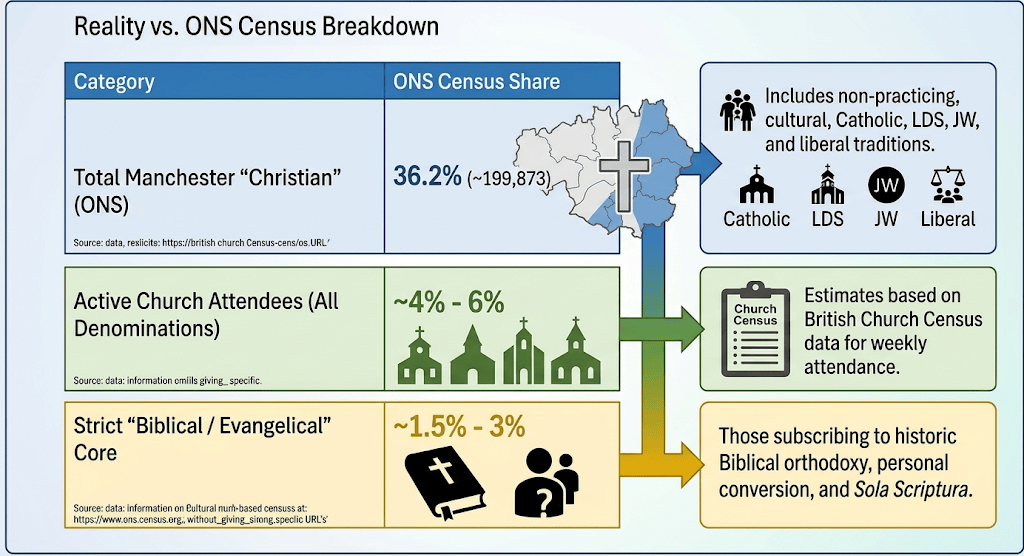
By conflating government sociological metrics with Biblical conviction, citing the 36% figure paints a misleading picture of Manchester’s spiritual reality. Unpacking this demographic reveals that the actual percentage of residents adhering to historic, scripture-based Christianity is only a small fraction of that official census total.
Breaking Down the 36.2%: Who Is Actually Included?
When you unpack the 199,873 people included in Manchester’s 36.2% census total, you find groups whose core doctrines diverge fundamentally from classical Evangelical or Sola Scriptura Biblical views:
3. The Census Detailed Classification Includes Very Different Christian Traditions
The ONS provides a much more detailed classification behind the broad headline categories. Its official Religion (detailed) classification contains 191 categories, including:
- Roman Catholic;
- Anglican;
- Evangelical;
- Pentecostal;
- Baptist;
- Methodist;
- Church of Jesus Christ of Latter Day Saints (Mormons);
- Jehovah’s Witnesses;
- Seventh Day Adventist;
- Orthodox churches;
- and many other Christian traditions.
This is important evidence. The Census itself recognises that people who identify with Christianity come from many different religious traditions. The broad headline “Christian” therefore tells us very little about an individual’s precise theological beliefs.
Roman Catholicism
Roman Catholicism is one of the detailed Christian categories recognised by the ONS. From a historic Protestant Evangelical perspective, Roman Catholic theology differs substantially from Reformation theology concerning matters including:
- the authority of Scripture;
- Sacred Tradition;
- the teaching authority of the Church;
- justification;
- and the sacraments.
Consequently, someone identifying as Roman Catholic in the Census cannot simply be assumed to possess the same theological framework as a historic Protestant Evangelical. The Census establishes religious identity. It does not establish whether an individual affirms Sola Scriptura, justification by faith alone, or the distinctive doctrines of historic Evangelical Protestantism.
4. Jehovah’s Witnesses and Latter-day Saints Further Demonstrate the Problem
The ONS detailed Census classification specifically includes “Church of Jesus Christ of Latter Day Saints (Mormons)” and “Jehovah’s Witness” as separate detailed religious categories.
This demonstrates another important limitation of the headline statistic: the broad Census category tells us that someone has identified with Christianity, but it does not tell us whether that person’s theology corresponds to historic Trinitarian Christianity or historic Protestant Evangelicalism.
Jehovah’s Witnesses reject the historic doctrine of the Trinity and deny the full deity of Christ. Latter-day Saint theology likewise differs substantially from historic Nicene and Protestant Christianity in its doctrines of God, Christ, revelation and Scripture.
The point is not that the Census is wrong to record how people identify themselves. The point is that a government statistic describing religious identification cannot itself function as a theological statement. A Census statistic can tell us how people identify. It cannot tell us what they believe about salvation, Scripture, God, Christ or the Gospel.
5. Cultural and Nominal Christianity Must Also Be Considered
The ONS methodology provides another important reason for caution.
Because religious affiliation is measured regardless of whether someone practises or has belief in the religion, the Christian category necessarily contains people whose actual religious practice and belief will vary considerably.
Some people may identify as Christian because of:
- family background;
- baptism;
- childhood upbringing;
- national or cultural heritage;
- or personal identification with Christianity.
Others may be committed and practising Christians.
The Census does not distinguish these groups by asking whether someone has experienced personal conversion, regularly attends church, reads the Bible, or agrees with particular doctrines; therefore, it would be misleading to take the entire 36.2% and treat it as though it represents a unified body of practising Christians who already share a common biblical worldview.
6. What About Church Attendance?
The difference between identity and practice becomes particularly clear when Census data are compared with church-attendance research.
The UK Parliament’s House of Commons Library published a 2024 Debate Pack using Brierley Consultancy statistics. It states that church-attendance statistics include Sunday attendance by denomination in England and Scotland and reports that in England the proportion of the population attending church on Sunday fell from 10% in 1980 to 5% in 2020.
This is an official parliamentary research source.
Source:
UK Parliament — Easter, Christian culture and heritage: Debate Pack (PDF)
More recent evidence comes from the National Centre for Social Research (NatCen) and the British Social Attitudes survey, its latest findings, published in May 2026, report that:
- 13% of Christians say they attend a religious service at least once a week;
- but only 5% of all British adults attend a Christian service weekly;
- compared with 8% in 2018.
NatCen’s methodology is particularly useful because it distinguishes religious identification from attendance. The survey asks respondents whether they regard themselves as belonging to a religion and then separately asks how often they attend religious services.
Source:
NatCen — No revival in sight: Church attendance in Britain remains below pre-pandemic levels
These are national figures, not Manchester-specific attendance statistics.
That distinction must be stated clearly; nevertheless, they demonstrate the enormous difference between:
“36.2% of Manchester identifies as Christian”
and:
“36.2% of Manchester regularly attends Christian worship.” the available evidence does not support the latter statement.
7. Even Church Attendance Does Not Equal Evangelical Belief
Another layer must be considered: even regular church attendance does not automatically establish historic Evangelical belief.
The Evangelical Alliance UK conducted research specifically examining evangelical identity and belief.
Its Understanding UK Evangelicals research reports approximately 2.6 million “Classic Evangelicals” in the UK, equivalent to 3.8% of respondents. The research defines this group as people who strongly hold evangelical beliefs, identify as evangelical, and belong to Protestant traditions.
The same research reports approximately 5.5 million “Broad Evangelicals”, equivalent to 7.9% of respondents, who hold evangelical beliefs and identify as evangelical.
It also reports that 7.2% of respondents are practising Christians, defined in that research as attending church at least monthly and praying and reading the Bible at least weekly.
These distinctions are extremely important; the Evangelical Alliance’s research (not an endorsement) demonstrates that we can distinguish between:
Christian identification and Christian practice and evangelical belief.
These are not interchangeable categories.
Source:
Evangelical Alliance UK — Understanding UK Evangelicals
8. Why the 36% Figure Can Be Misleading in an Evangelistic Context
This brings us back to the way Census statistics function in an evangelistic setting, when an audience hears:
“36% of Manchester is Christian,”
it is easy for the statement to create the impression that approximately one-third of the city already possesses a meaningful Christian understanding, but the Census does not establish that.
The 36.2% figure represents religious identification.
It does not establish:
- biblical literacy;
- church attendance;
- personal conversion;
- evangelical belief;
- belief in Sola Scriptura;
- or agreement with the historic Protestant understanding of salvation.
The population represented by the statistic contains people from different Christian traditions and people with very different levels of religious practice and belief.
The ONS detailed classification itself demonstrates this diversity, listing Roman Catholic, Evangelical, Pentecostal, Baptist, Methodist, Latter-day Saint and Jehovah’s Witness categories among its detailed religion responses.
Because the Census does not establish the theological position or level of practice of each individual, the 36.2% headline should not be treated as a measure of Manchester’s Evangelical Christian population.
9. Reality Versus the Census Headline
The evidence is better understood when the different measurements are kept separate:
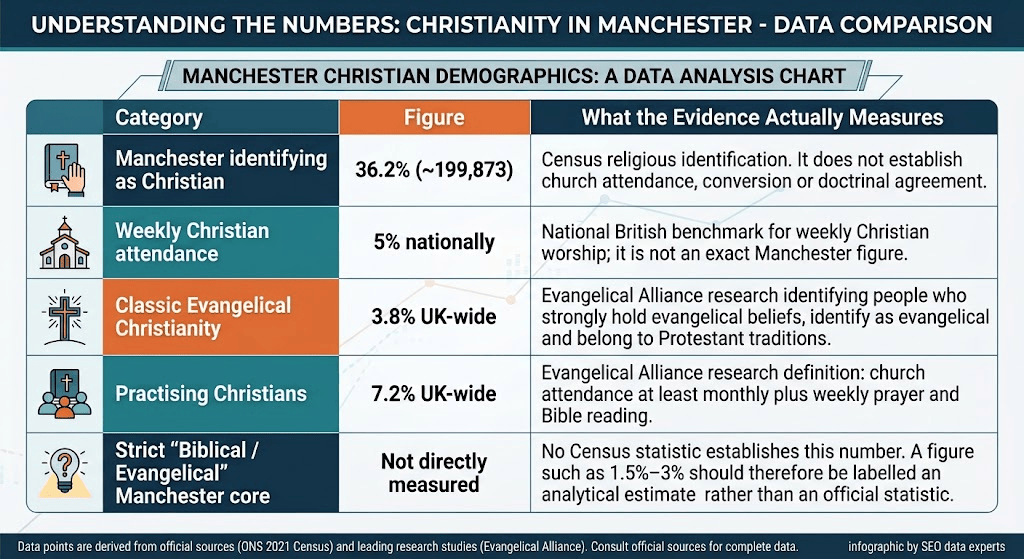
The crucial point is that these figures cannot simply be combined or substituted for one another.
The 36.2% figure is a Manchester Census measure of religious identification.
The 5% figure is a national measure of weekly Christian attendance.
The 3.8% figure is a UK-wide measure of a particular evangelical belief-and-identity group.
They answer different questions.
10. The Three Different Measurements
The methodological distinction can be summarised very simply:
The Census measures Identity
“What religion do you identify or connect with?”
The ONS explicitly defines Census religion in these terms.
Attendance surveys measure Practice
“How frequently do you attend Christian worship?”
The British Social Attitudes survey separately measures religious identity and attendance.
Evangelical research examines Identity and Belief
“Do you identify as evangelical, and do you affirm the characteristic beliefs of evangelical Christianity?”
The Evangelical Alliance research specifically distinguishes different evangelical categories according to identity and belief.
These are three different measurements.
They should not be collapsed into a single headline statistic.
Conclusion: What Does the 36% Actually Tell Us?
The 2021 Census tells us something important:
36.2% of Manchester residents identified as Christian.
Manchester City Council confirms that this represented 199,873 residents.
But the ONS itself tells us what this figure does — and does not — mean.
It measures religious affiliation: the religion with which people connect or identify, whether or not they practise or have belief in it.
Therefore, the statistic does not establish that 36.2%:
- regularly attend church;
- have been born again;
- understand the biblical Gospel;
- believe in Sola Scriptura;
- hold historic Protestant doctrine;
- or are practising Evangelical Christians.
The Census gives us identity.
Attendance research gives us practice.
Evangelical research gives us belief and evangelical identity.
These measurements must be kept distinct.
When evaluating Manchester as a mission field, the 36.2% Christian Census figure should therefore not be treated as though it represents a unified body of converted, practising Evangelical Christians.
The crucial questions for an evangelistic campaign are not simply:
“How many people call themselves Christian?”
but:
“How many regularly practise the Christian faith?”
“What do they actually believe about Scripture, Christ and salvation?”
“How many understand the biblical Gospel?”
“And how many genuinely trust in Christ?”
That is why the 36% headline figure requires qualification.
The statistic itself is not false.
The danger is drawing a theological conclusion from a sociological statistic that was never designed to provide one.
Primary Sources and Official References
Office for National Statistics – Religion (detailed), Census 2021
Defines Census religion as religious affiliation, whether or not people practise or believe in it.
ONS – Religion (detailed) variable
Office for National Statistics – Religion question development for Census 2021
Explains that the Census measures religious affiliation rather than belief or active practice.
ONS – Census 2021 religion question development
Office for National Statistics – Manchester Census 2021
Reports 36.2% Christian in Manchester and explains that religious affiliation is not the same as belief or practice.
ONS – How life has changed in Manchester: Census 2021
Manchester City Council – Census 2021 Identity Summary
Reports the official figure of 199,873 Manchester residents recorded as Christian.
Manchester City Council – Census 2021 Identity Summary
UK Parliament – Commons Library Debate Pack
Reports Brierley Consultancy’s England church-attendance figures, including the fall from 10% in 1980 to 5% in 2020.
UK Parliament – Easter, Christian culture and heritage (PDF)
National Centre for Social Research – British Social Attitudes
Reports that only 5% of British adults attended a Christian service weekly in the latest survey.
NatCen – Church attendance in Britain remains below pre-pandemic levels
Evangelical Alliance UK – Understanding UK Evangelicals
Provides the 3.8% “Classic Evangelical” and 7.9% “Broad Evangelical” UK-wide figures and its definition of practising Christians.
Evangelical Alliance – Understanding UK Evangelicals
Views: 10
Discover more from UK Apologetics Library
Subscribe to get the latest posts sent to your email.
You must be logged in to post a comment.