


Why Christians Should Be Cautious About Franklin Graham and the Problem with Pragmatic Defence
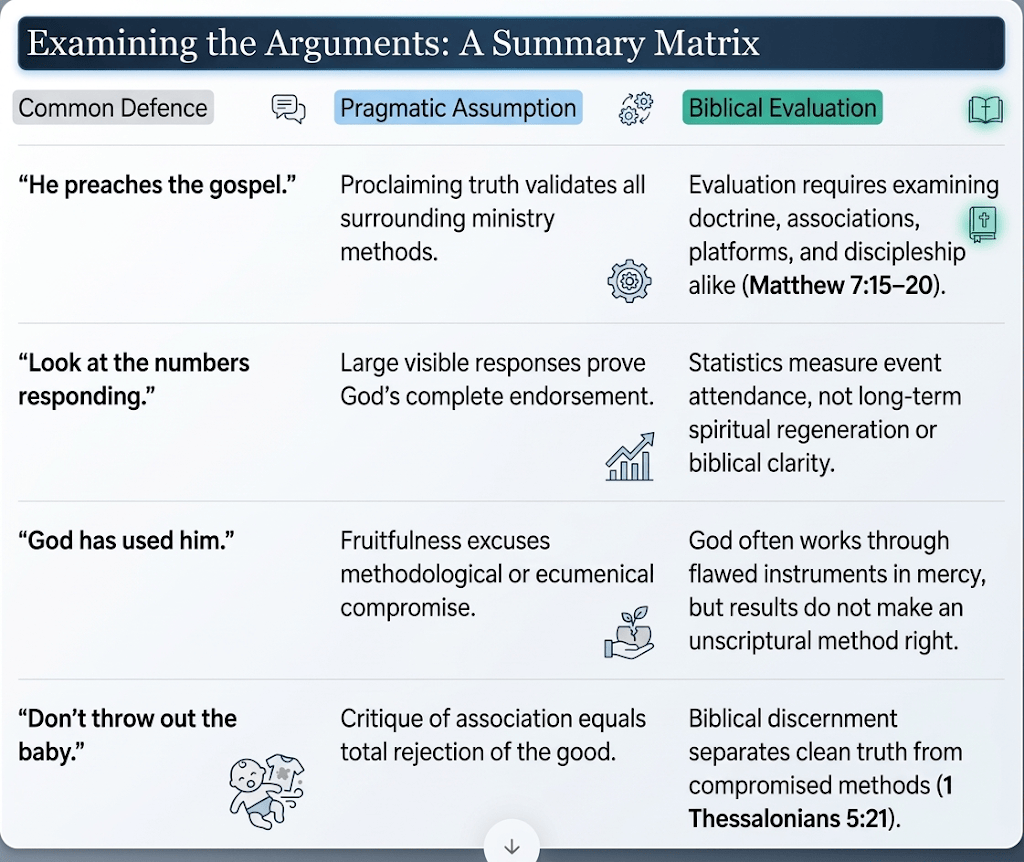
The saying, “Don’t throw the baby out with the bathwater,” contains an important principle. Christians should not reject everything simply because something contains elements with which they disagree. We should be fair, careful, and willing to acknowledge what is true and good.
But the phrase can also become a slogan that discourages biblical examination. When applied to Christian ministry, it can effectively mean: “Yes, there may be problems, but look at all the good that is happening.”
That is not the standard Scripture gives us.
The Bible repeatedly commands Christians to exercise discernment. The Bereans were commended because they “searched the scriptures daily, whether those things were so” (Acts 17:11). Paul instructed believers to “prove all things; hold fast that which is good” (1 Thessalonians 5:21). John instructed Christians, “believe not every spirit, but try the spirits whether they are of God” (1 John 4:1). And Paul warned the Galatians that even a message delivered by an angel was not to be accepted if it contradicted the true gospel (Galatians 1:6–9).
The principle is therefore clear: No Christian leader is above examination. That includes Franklin Graham.
A Fair Starting Point: Franklin Graham Does Preach the Gospel
It is important to begin fairly. Franklin Graham publicly preaches central Christian truths. His preaching includes the reality of sin, judgment, repentance, the death and resurrection of Jesus Christ, and the necessity of turning to Christ.
His evangelistic ministry has also produced visible responses. For example, the Billy Graham Evangelistic Association (BGEA) has reported large attendances and hundreds of decisions at recent God Loves You Tour events.
Those things should not be denied simply because one has concerns about other aspects of the ministry.
- If Franklin Graham clearly proclaims the biblical gospel at an event, Christians should acknowledge that.
- If people genuinely repent of sin and trust in Christ, we should rejoice.
- If his ministry gives Christians opportunities to hear the gospel, that is a good thing.
The Essential Distinction: The truth of a message is not identical to the legitimacy of everything surrounding the message. A preacher can say something biblically true while other aspects of the ministry deserve examination.
The question is therefore not whether Franklin Graham has ever preached the gospel. He has. The question is whether that fact means that everything connected with his ministry should automatically be accepted. It does not.
The Question Is Not Merely Whether Someone Preaches the Gospel
Suppose a preacher stands before thousands of people and clearly explains that sinners need to repent and trust in Jesus Christ. That is good. But Scripture does not instruct Christians to evaluate teachers solely by examining isolated statements. We are also told to examine teaching, doctrine, conduct, associations, and fruit (Matthew 7:15–20).
The New Testament gives us a broader framework of discernment. We should ask:
- What is being preached? What is being affirmed, and what is being denied?
- Who is being given a platform? Who is being presented as a representative of Christianity?
- What doctrines are being treated as compatible? What theological distinctions are being made clear, and what distinctions are being minimised?
- What happens to people after they respond? Where are inquirers directed for discipleship?
These questions become particularly important when an evangelistic ministry deliberately cooperates with churches and religious leaders from substantially different theological traditions.
Stage-Managed Ecumenism and Platform Endorsement
One of the broader concerns raised by critics of contemporary evangelicalism is what has sometimes been called platform ecumenism, practical ecumenism, or back-door ecumenism.
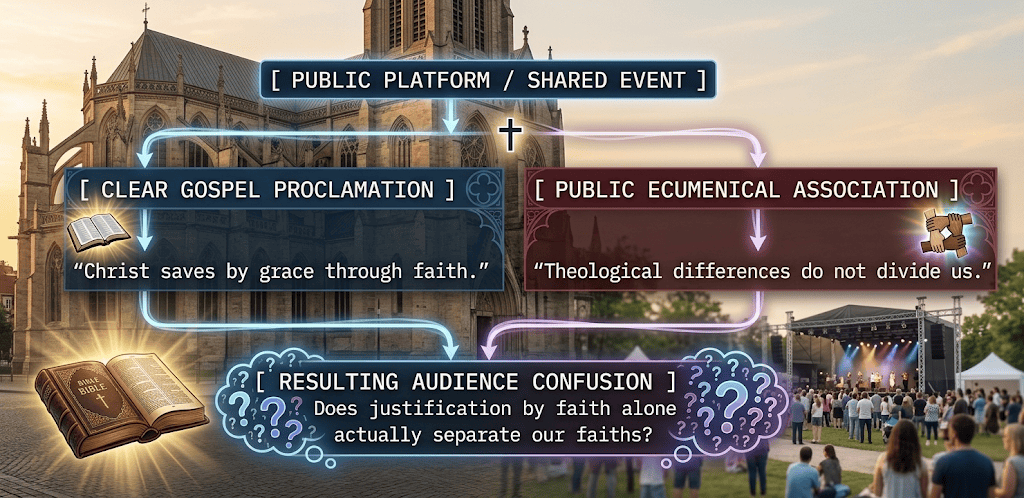
The basic concern is straightforward: A Christian leader does not necessarily have to sign a formal theological agreement with another religious leader in order for cooperation to communicate something to the public. They can simply share a platform, pray together, participate in the same campaign, or cooperate in counselling and follow-up.
To the average person watching, these actions can communicate that the participants are sufficiently united to represent Christianity together.
Why Public Association Matters
The average attendee may not understand the distinctions between evangelical Protestantism, Roman Catholicism, Anglicanism, Eastern Orthodoxy, or liberal Protestantism. When religious leaders stand together on the same platform, the audience naturally assumes that their theological differences are not significant enough to prevent joint ministry.
The issue is not that association automatically proves complete doctrinal agreement. The issue is that public association communicates legitimacy, unity, and trust, gradually normalising deep theological divisions.
The Billy Graham Legacy & The Question of Follow-Up
These concerns must be considered in the context of the broader Billy Graham evangelistic model. Critics have long argued that Billy Graham’s crusades involved cooperation with Roman Catholic clergy and other traditions that did not share historic evangelical Protestant convictions concerning salvation and justification.
The concern was not simply that Catholics attended. It was that Catholic counsellors and churches were involved in the follow-up of people responding to the evangelistic invitation.
Key Discipleship Questions:
- If a person responds to an invitation to come to Christ, what church receives that person?
- Who counsels them?
- What doctrine are they taught regarding justification and salvation?
Those are not secondary questions. They concern the very heart of the Great Commission (Matthew 28:19–20).
Further Evidence: Prayer Gatherings and Public Analysis
The concerns surrounding Franklin Graham extend beyond crusade follow-up to broad interdenominational and interfaith prayer events.
A relevant example appears in The Berean Call programme “Apostasy #28: Can A Religious Pluralistic Society Please God?” (January 15, 2021). Analysts T. A. McMahon and Dave James discussed the large prayer gatherings held in Washington, D.C., in September 2020.
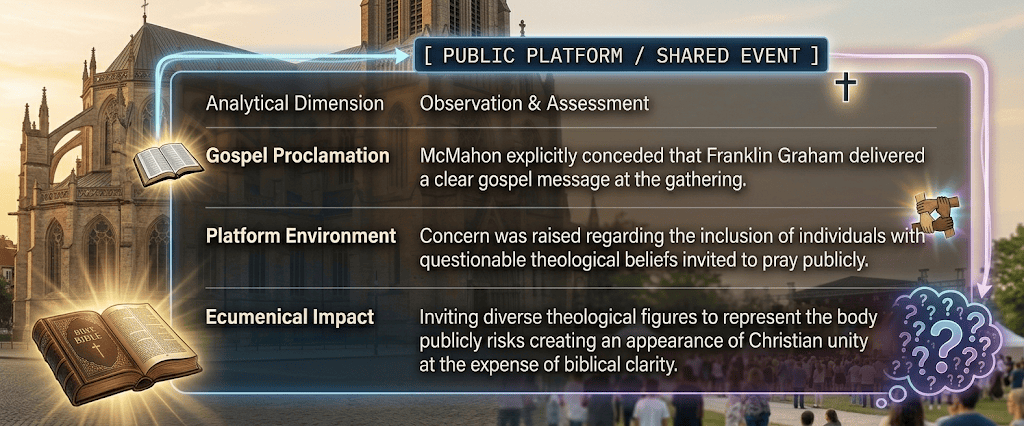
The underlying question is legitimate: What theological standard governs whom a Christian leader invites to represent Christianity publicly? That question cannot be answered merely by pointing out that the leader himself preached the gospel.
The Pittsburgh Example: A Case Study in Follow-Up
A concrete example concerns Franklin Graham’s 2014 Three Rivers Festival of Hope in Pittsburgh. Reports surrounding the event state that Roman Catholic Bishop David Zubik participated publicly and gave the opening prayer.
More significantly, reporting indicated that Catholic representatives were prepared to receive Catholics who responded to Graham’s invitation and direct them toward Catholic pastoral ministry, including the sacrament of reconciliation (confession).
A Necessary Nuance on Sources
Some of this reporting derives from discernment organisations like Lighthouse Trails Research, which take a strongly separatist position. It is important to distinguish historical facts from theological conclusions:
- The Historical Claim: Catholic clergy participated publicly, and Catholic respondents were directed toward Catholic pastoral structures.
- The Interpretive Conclusion: Claims that Graham was actively directing people toward “another Jesus” represent theological assertions by critics rather than simple objective narrative.
Even without adopting every hyper-separatist conclusion, the underlying core issue remains: If an evangelical campaign directs inquirers into a sacramental system that denies sola fide (faith alone), Christians have legitimate grounds to question whether the process yields biblical discipleship.
The Catholic Understanding of Salvation Must Be Considered
It is sometimes said that Catholics and evangelicals agree on “the fundamentals”: Christ’s deity, His incarnation, His death, and His resurrection. There is truth in that observation. But Christianity cannot be reduced to a list of propositions concerning the identity of Jesus.
The apostles were deeply concerned with how sinners are justified before God. Paul’s argument in Galatians demonstrates that the doctrine of justification is not an optional detail the gospel itself is at stake when the basis upon which a sinner is declared righteous is altered.
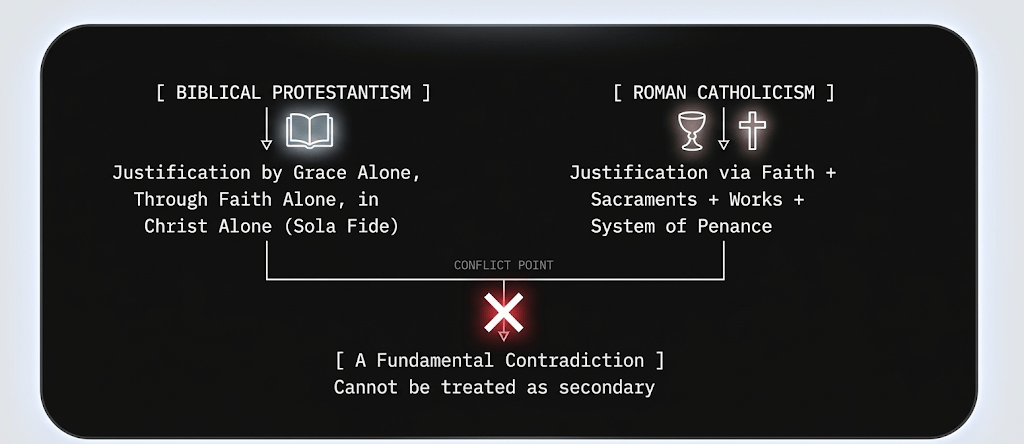
We can love Catholics as neighbours while maintaining that particular Roman Catholic doctrines are inconsistent with the biblical gospel. Opposing theological error does not require impugning the sincerity or motives of every individual.
The Real Problem Is Pragmatism
At the heart of this entire debate is the collision between two fundamentally different frameworks:
Pragmatism asks: Does this produce results? Are people responding? Can we work together to fill stadiums and produce statistics?
Biblical Discernment asks: Is this true? What are people responding to, and where are they sent afterward? Is the basis of cooperation faithful to Scripture?
Pragmatism makes theological differences appear inconvenient. But Scripture does not permit Christians to sacrifice doctrinal clarity merely because cooperation produces visible, large-scale results.
Conclusion: We Should Be Cautious Without Being Reckless
Biblical discernment is not permission to become suspicious of everyone, nor does every association prove total doctrinal compromise. Christians must distinguish between verified evidence and sweeping inference.
The issue is not simple “guilt by association.” The issue is whether a consistent pattern of public association, shared platforms, and ecumenical follow-up creates theological confusion.
We do not need to throw out the baby. We need to examine the bathwater.
The gospel belongs to Christ. The church belongs to Christ. The truth belongs to Christ. No Christian celebrity, evangelistic organisation, or parachurch ministry has the authority to redefine those boundaries.
Our responsibility remains simple, though demanding: Search the Scriptures. Test the teaching. Examine the associations. Investigate the follow-up. Distinguish fact from interpretation. Acknowledge what is good. Reject what is false. And above all, remain faithful to Christ and His Word.
Views: 7
Discover more from UK Apologetics Library
Subscribe to get the latest posts sent to your email.
You must be logged in to post a comment.