

The ancient pagan labyrinth or spiral is being promoted as a means of “healing” and meditation in Christian churches. [According to David Crumm; The Providence Journal, Saturday, July 11, 1998, page D5].
The History of the Labyrinth (when used as an aid to personal spiritual formation).
4500 BC [Prehistoric – Early Neolithic (Stone Age) tribes] Labyrinths have been around for thousands of years. The oldest known constructed labyrinths were built around 4500 BC in Ancient Egypt and what is now central Italy to ward off evil spirits. The Romans created mosaic patterns on the floors of public buildings and houses for the same reason.
4000 BC [Neolithic – Stone Age Pagan Culture]
The very early representations of the Labyrinth have been found on pottery shards dating back to prehistoric times.
Glastonbury – Britain
The earliest tribes were wholly concerned with keeping their landscape in the same state of nature as they found it. No doubt they regarded the Tor as a place of initiation, but they are not likely to have engraved marks upon it. The labyrinth, then, must have been carved after settlement, from about 4000 BC. That places it within the age of the giants. It is indeed a typical product of that age. Even though it was always before everyone’s eyes, its scale is gigantic. From New Light on the Ancient Mystery of Glastonbury, by John Michell – http://www.gothicimage.co.uk/books/newlight1.html
3600 BC
Pliny records the construction of an impressive labyrinth around 3600 BC.
2500 BC
Apparently labyrinths have been around forever, and appear in places that had no connection to each other (and thus couldn’t have transferred the work) – at the same time as the classical Greek labyrinth there were nearly identical Native American labyrinths. A prehistoric petroglyph on a riverbank in Goa shows the same pattern and has been dated to circa 2500 BC.
2000 BC
The labyrinth was still in use is not solely used by any one cultural group today. Early Christian Labyrinths date back to 4th century B.C.
1200 BC
A labyrinth was documented on a clay tablet from Pylos, Greece, and dated to circa 1200 BCE. The earliest Christian labyrinth dates back to the 4th century: a basilica in Algeria; see below. http://7fountains.wordpress.com/labyrinth/
Fig. 1 – From Greek Mythology the Minotaur half bull & human at the centre of the labyrinth.
Ariadne was the daughter of King Minos and Pasiphaë who gave Theseus the thread with which he found his way out of the Minotaur’s labyrinth. [Ariadne means most holy]. Greek mythology did not recall, however, that in Crete there was a Lady who presided over the Labyrinth. An inscribed tablet found at Knossos records a gift “to all the gods honey; to the mistress of the labyrinth honey.” All the gods together receive as much honey as the Mistress of the Labyrinth alone. “She had much greater authority must have been a creational goddess”.
Professor Barry Powell has suggested that the folklore heroine, Ariadne, was the Minoan Crete’s Snake Goddess reduced in legend. Powell, Barry B. Classical Myth. Second ed. with new translations of ancient texts by Herbert M. Howe. Upper Saddle River, New Jersey: Prentice-Hall, Inc., 1998, p. 368.
This goddess figure appears in many cultures worldwide and is often associated with labyrinths. The contemporary resurgence of labyrinths in the West stems from our deeply rooted urge to honour the Sacredness of all life again. A labyrinth can be experienced as the birthing womb of the Great Goddess. The labyrinth experience is a potent practice of Self-Integration as it encapsulates the spiralling journey in and out of incarnation. On the journey in, towards the centre, one cleanses the dirt from the road. On the journey out, one is born anew to consciously dwell in a human body, made holy by having had a taste of the Infinite Centre. There are parallels to the snake, which sheds its old skin to be ‘made new’ and is often found in a coiled state.

Fig. 2- Crete -Minoan Snake Goddess figurines c 1600 BCE.

Fig. 3 – Gotland, Sweden
The snake goddess has been compared to the Snake-witch picture stone
which shows a woman holding snakes in both hands.

Fig. 4 – Furious Maenad: Staatliche Antikensammlungen, Munich, Germany. She holds a thyrsus in her right hand and, with her left hand, shakes a panther. A snake is coiled over her head. [The thyrsus was a sacred instrument used at religious rituals].
Snake Goddess
A number of figurines of a woman holding a snake in each hand were found during the excavation of Minoan archaeological sites in Crete dating from approximately 1600 BCE. By implication, the term ‘snake goddess’ also describes the Chthonic deity depicted, although little more is known about her identity beyond what the figurines reveal.
Chthonian adj. Of or relating to the underworld; being of the underworld or infernal regions. Gk. mythology

Fig. 5 – Drinking scene with Dionysus and Ariadne on his lap, Greco-Buddhist art from Gandhara, 3rd century CE. [Gandhara is also a proposed name for Khyber Pakhtunkhwa province in Pakistan].
324 AD
This is the point in the timeline where we first encounter the labyrinth being used in ‘Christian’ practices. See section below: First known point of entry into the “Christian” camp.
1201 AD
Perhaps the most famous surviving labyrinth is found at the Cathedral in Chartres, France. One of the ways labyrinths were employed in Medieval Roman Catholic Monasticism was as a substitute pilgrimage.
If you were unable to travel on pilgrimage because of physical or economic restraints, ‘walking the labyrinth’ with discomfort (usually on bare knees) was often considered a sufficient substitute and the church prescribed what you needed to do to receive the necessary indulgence for your sins. (according to R.C.C.). Only knowledge of God’s Word would equip you to refute this heretical controlling dictum.
The largest now remaining church based labyrinth is that in Chartres Cathedral which is formed of blue and white stones and is about 40 ft. in diameter.
Throughout a very long period of European history the church (Rome) ministered their own brand of spirituality that, over time, progressively migrated further from the Apostolic faith; largely through their ongoing development of church tradition. They find themselves locked in with practices that are deeply and offensively unbiblical and as the promoted fad for mysticism catches the imagination; Rome sinks even deeper into sin, Manchester Cathedral, England also wickedly elects for this spiritual abyss too.
1779 AD
The labyrinth in Rheims Cathedral was destroyed by ecclesiastical order because children made too much noise playing on it during services!
1998 AD
On 10 May 1998 the New York Times published a front page story entitled “Reviving labyrinths, a path to inner peace.” Within the next few days the principal Web site for mazes (Grace Cathedral) registered no fewer than 15,000 hits from people wishing to learn about Labyrinths. http://www.gracecathedral.org/visit/labyrinth/ This phenomenon was covered here: The maze and the warrior Related web pages books.google.com/books?id=e-wGs_-9H8IC&pg=PA1
1999 AD
The inaugural annual gathering in Denver, USA of the Labyrinth Society (LS) was launched.
First Plumbline Comment: This society comprises a very mixed membership from a Biblical perspective. Essentially every participant and supporter of LS is acting contrary to the teaching of the Word of God. Some do not accept Biblical teaching because they come from many different religious or non-religious (spiritual) backgrounds, so their position is not uncharacteristic. Many members claim to be Christian and not a few hold the office of Christian minister; however they are identifiably anti-Christian in their practices and ethos and are accomplished deceivers. “with all deceivableness of unrighteousness in them that perish; because they received not the love of the truth, that they might be saved” 2 Thess. 2:10
ANCIENT PAGAN LABYRINTHS OUTSIDE EUROPE

Fig. 7 – Hindu Labyrinth
Carving showing the warrior Abhimanyu entering the chakravyuha – Hoysaleswara temple, Halebidu, India. This depiction comes from ancient Hinduism, specifically the epic tale of the Mahabharata. The word Chakravyuha is made up of Chakra, meaning circle or ring, and Vyuha,, meaning formation. Hence it is a ring formation labyrinth, consisting of 7 concentric circles. Other examples have been found among cave art in northern India and on a dolmen shrine in the Nilgiri Mountains, but are difficult to date accurately. Early labyrinths in India all follow the Classical pattern.
Native American Labyrinths
The labyrinth symbol in the American Southwest is both widespread and shrouded in mystery. How, and more importantly when, the symbol first reached this region is unclear. Labyrinth petroglyphs found throughout Arizona, New Mexico, and northern Mexico are difficult to date, but provide the earliest evidence of labyrinths in the Southwest. Among those tribes that use the labyrinth, the native peoples of Arizona are the Tohono O’odham and Navajo Indians.
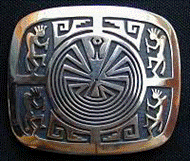
Fig. 8 – Navajo silver belt buckle

Fig. 9 – Petroglyph, Arroyo Hondo, NM
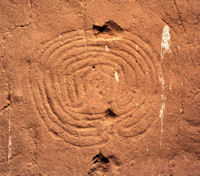
Fig. 10 – Petroglyph, Arroyo Hondo, NM
Mt. Baboquivari, Inscription, Casa Grande, AZ
South & Central America Spiritual Folklore
Quetzalcoatl depicted as a snake devouring a man, from the Codex Telleriano-Remensis. In America some of the Native American tribes give reverence to the rattlesnake as grandfather and king of snakes who is able to give fair winds or cause tempest. Among the Hopi of Arizona the serpent figures
largely in one of the dances. The rattlesnake was worshipped in the Natchez temple of the sun and the
Aztec deity Quetzalcoatl was a feathered serpent-god. Quetzalcoatl depicted as a snake devouring a man, from the Codex Telleriano-Remensis.
The Serpent again playing an important role in primitive pagan cultures. What is the source of all this?
Why is this found across the globe in so many cultures at a time when travel was so difficult? Is there a connection between labyrinths, serpents and mysticism? This clearly is not Christian but pagan and devilish.
Fig. 10 – Petroglyph, Arroyo Hondo, NM
Mt. Baboquivari, Inscription, Casa Grande, AZ
South & Central America Spiritual Folklore
Quetzalcoatl depicted as a snake devouring a man, from the Codex Telleriano-Remensis. In America some of the Native American tribes give reverence to the rattlesnake as grandfather and king of snakes who is able to give fair winds or cause tempest. Among the Hopi of Arizona the serpent figures
largely in one of the dances. The rattlesnake was worshipped in the Natchez temple of the sun and the
Aztec deity Quetzalcoatl was a feathered serpent-god. Quetzalcoatl depicted as a snake devouring a man, from the Codex Telleriano-Remensis.
The Serpent again playing an important role in primitive pagan cultures. What is the source of all this?
Why is this found across the globe in so many cultures at a time when travel was so difficult? Is there a connection between labyrinths, serpents and mysticism? This clearly is not Christian but pagan and devilish.
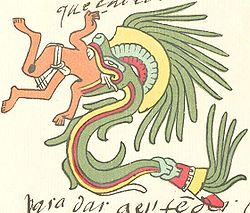
Fig. 11 – Aztec deity Quetzalcoatl was a feathered serpent-god
Why would Christians want to seek God through experiences that can only be described as occult? Are they Christians or imposters? Are they fully aware they are leading others astray? These same people at Manchester Cathedral have been previously warned about their anti-Christian event calendar. They persist to act in open defiance to the Scriptures and before God they have no excuse.
“Now the Spirit speaketh expressly, that in the latter times some shall depart from the faith, giving heed to seducing spirits, and doctrines of devils; Speaking lies in hypocrisy; having their conscience seared with a hot iron ….”. 1 Timothy 4:1-2
Labyrinths 2000-3000 years old
By the White Sea notably on the Solovetsky Islands, (Russian Federation) there have been preserved more than 30 stone labyrinths. The most remarkable monument is the Stone Labyrinths of Bolshoi Zayatsky Island – a group of 13–14 stone labyrinths on a0.4 km2 area of one small island. http://en.wikipedia.org/wiki/Stone_labyrinths_of_Bolshoi_Zayatsky_Island
(1991). Journal of Analytical Psychology, 36:461-481
Immersions in Ambiguity: The Labyrinth and the Analytic Process
Caroline Savitz, M.A., M.S.W., C.S.W.
Before Aeneas descends to the underworld to visit his father’s shade, he arrives at Apollo’s temple at Cumae. Here, he stops to study the carvings on the temple gates that tell the story of ‘the inextricable labyrinth, the house of toil’
(Virgil 19, Bk 6, p. 134):
“the labyrinth in high Crete had a path built out of blind walls, an ambiguous maze of a thousand ways, a winding course that mocked all signs of finding a way out, a puzzle that was irresolvable and irretraceable (ibid., Bk 5, pp. 123-4)
Experiences of ‘inextricability’ and ‘toil’, of ‘blind walls’, of ‘a winding course’, of an ‘irresolvable and irretraceable puzzle ‘, these words and corresponding imagery that belong to the essence of the labyrinth come to mind most readily in attempting to understand the often ambiguous and irresolvable nature of the transference. The twisting and turning of the analytic process, the dead ends. Psychoanalytic Electronic Publishing http://www.pep-web.org/document.php?id=joap.036.0461a
UK Apologetics Library Comment:
Thus far, we have presented various aspects of the Labyrinth and its use throughout history. This has been by no means an exhaustive study; it would require a whole book to examine the subject in sufficient depth. Our task is to clearly warn and equip the Body of Christ against such heinous heresy.
The subject matter surrounding The Spirit of Life Event involves some truly wicked practices and principles. However, the Christian should in no way allow curiosity to draw them into this occult mind maze. It is dangerous and contains seductive enchantments lying in wait. Instead, we must heed the warning of Scripture:
“Put on the whole armour of God, that ye may be able to stand against the wiles of the devil. For we wrestle not against flesh and blood, but against principalities, against powers, against the rulers of the darkness of this world, against spiritual wickedness in high places.” Ephesians 6:11–12
Satan is currently alive and well, and his influence is quite possibly INSIDE YOUR CHURCH. Even more worrying is the fact that the Adversary may be exerting influence, either subtly or not so subtly, from WITHIN THE PULPIT!
Before we move on to the subject of “Walking the Labyrinth,” review carefully what you have read above. It should be perfectly clear that the use of the Labyrinth as a spiritual or religious practice does not have its origins within Christianity. It found its way into the “Church” during the fourth century A.D. and did not become more widely established until the Middle Ages. We shall examine this more carefully and provide the reasons for this in due course.
At this point, however, I want to establish that this practice has been very foolishly adopted into Christendom, despite belonging, in its origins and associations, to pagan religious culture.
True Christians already have access to God through the Lord Jesus Christ. We have truth that is readily accessible through the Word of God, and we have a Teacher and Comforter in the Holy Spirit. The message God has given us is His truth. It is absolute, immutable, inerrant and infallible, and for the believer it is “a lamp unto my feet, and a light unto my path.”
Christians have no need to embark upon occult mystery tours into forbidden territory. Those attending Body, Mind & Spirit fairs should deeply repent and come out from these temples of darkness and deception, turning instead to the true source of help and deliverance from spiritual darkness and bondage.
“And I saw an angel come down from heaven, having the key of the bottomless pit and a great chain in his hand. And he laid hold on the dragon, that old serpent, which is the Devil, and Satan, and bound him a thousand years….”
First Known Entry Point of Labyrinths into the “Christian” Camp
324 AD
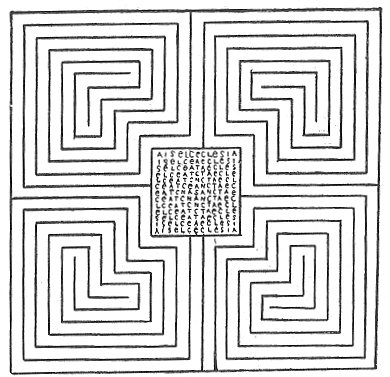
The use of the labyrinth did not originate within Christianity. Labyrinth designs were already known in the ancient Greco-Roman world, including their use in Roman mosaic pavements, before examples appeared within Christian buildings. One of the earliest known examples of a labyrinth in a Christian context is found at the Basilica of St. Reparatus at ancient Castellum Tingitanum, near present-day Chlef (formerly Orléansville/Al-Asnam), approximately 100 miles west of Algiers in North Africa. The basilica is associated with the fourth century, with its foundations traditionally dated to 324 A.D.
The labyrinth is a square Roman-style mosaic pavement. At its centre is a remarkable letter-square containing the words “SANCTA ECCLESIA” (“Holy Church”), which can be read from the central letter in multiple directions, although not diagonally. The incorporation of this Christian inscription into an established Roman labyrinth design provides a striking example of an older artistic motif being adapted and given a distinctly Christian interpretation.
This is historically significant. It demonstrates that the labyrinth motif was not created by Christianity but was adopted into a Christian setting and given a new religious meaning. The surrounding Greco-Roman world already possessed a long tradition of labyrinth imagery, including mosaics associated with the stories of Theseus and the Minotaur. The Christian example therefore represents not the invention of the labyrinth by the Church, but its incorporation and reinterpretation within a Christian environment.
From an apologetic perspective, this raises an important question: does giving an existing symbol a Christian interpretation automatically make the practice biblical? The answer must be established from Scripture rather than simply from the fact that a practice was eventually accommodated within Christian tradition.
It is also important to distinguish historical evidence from interpretation. There is evidence that practices and symbols from the wider Greco-Roman cultural environment were incorporated and reinterpreted within Christianity. However, the stronger assertion that monastic asceticism itself was a deliberate or “natural entry point” for pagan mystical practices requires separate evidence and should not be presented as an established historical fact without supporting documentation.
Nevertheless, the history of the labyrinth demonstrates an important principle: a practice can acquire Christian terminology, symbolism or interpretation without thereby acquiring a biblical origin. This distinction matters especially when examining the later development of labyrinths in medieval Christianity and, more recently, their revival in contemporary contemplative and “prayer labyrinth” movements.
Often packaged as Ancient-Modern Spirituality it lends the false, notion that this is age old orthodox Christianity. The ancient aspect has been shown to comprise of diverse aspects of paganism and mystery religions (Gnosticism), the modern aspect is “Christian”, albeit well departed from the apostolic faith.
So we have the “visible church” of Jesus Christ imbibing Satanic methodologies, which is precisely what the Adversary designs. These corrupting influences and practices go by a variety of names (Spiritual Formation, Contemplative Spirituality, and many others), but the endpoint is the same. The heretical doctrines of deceiving spirits. You can damn your soul in new (age) spiritual enchantments.
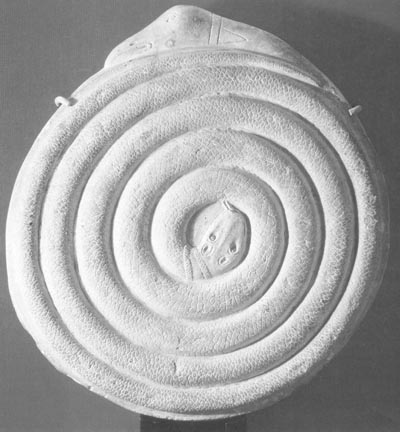
An ancient depiction of a labyrinth.
The Serpent, the Circle and the Labyrinth
The use of circles and circular designs is found throughout a variety of occult and esoteric traditions. Groups and practitioners associated with Satanism, Wicca, witchcraft and other forms of occultism have employed circles within ritual practices. In some traditions, so-called magic circles are used as part of rituals intended to cast spells, summon or invoke spiritual beings, or establish a ritual boundary.
With this in mind, consider the design of the labyrinth illustrated above. Here we are presented with a winding, circular pathway around which a person is instructed to walk. More significantly, the particular design appears to resemble a coiled serpent, with the head positioned at the centre and the tongue protruding.
The symbolism is difficult to overlook.
The serpent has long been associated with pagan religious symbolism and occult traditions. In the biblical account, the serpent is introduced in Genesis as the creature through which Satan deceived Eve:
“Now the serpent was more subtil than any beast of the field which the LORD God had made.”
Genesis 3:1
The New Testament subsequently identifies the ancient serpent with Satan himself:
“And the great dragon was cast out, that old serpent, called the Devil, and Satan, which deceiveth the whole world.”
Revelation 12:9
Therefore, when a labyrinth design appears deliberately to reproduce the form of a coiled serpent, with the serpent’s head positioned at its centre, it is reasonable to ask what symbolism is being communicated and what historical or religious traditions lie behind that imagery.
We should therefore not simply dismiss the possibility of pagan symbolism being present in such a design. The wider context is also significant. The modern New Age Movement incorporates and combines elements drawn from numerous religious and esoteric traditions, including ideas associated with ancient Egyptian and Mesopotamian religions, Eastern religious traditions such as Hinduism and Buddhism, occultism, mysticism and various forms of esoteric spirituality.
The issue, therefore, is not merely the shape of the labyrinth itself. It is the symbolism, historical development and spiritual meaning attributed to the practice.
For the Christian, this raises an important question: when an ancient symbol is adopted and placed within a Christian setting, does giving that symbol a Christian interpretation necessarily make the practice itself biblical?
That question must be examined carefully rather than assumed. Scripture repeatedly warns believers to exercise discernment and to reject practices that originate from spiritual systems contrary to the worship of the true God.
The Christian therefore has every reason to examine the labyrinth not merely by asking what modern practitioners say it represents, but by asking where its symbolism came from, how it developed historically, and whether the practice of walking it has any genuine foundation in Scripture.
The Causative Conditions for the Ingress of Pagan Practices
These adverse Gnostic elements, as already mentioned, became associated with the development of Roman Catholicism and, in particular, with the culture of monasticism, which was itself influenced by various secular philosophical traditions. The problem was compounded by unscriptural influences arising from the continual additions to church authority through the traditions of the Catholic Church.
The final straw was the authoritarianism that developed to maintain conformity within the Church under the Papacy and Magisterium. This system strongly resisted correction from outside itself.
Rome’s system stifled true, individual, Biblically derived spiritual growth and maturity by establishing an authoritarian and fixed form of Divine worship. It comprised an unbiblical liturgical format, including responses learned by rote, thereby stultifying Biblical understanding and spiritual proficiency.
An experience of the Mass administered through a go-between, the priest, became, in this system, the principal means through which the ordinary believer encountered God. This could create dependence on the priesthood and the formal religious system rather than encouraging believers to develop personal knowledge of God through Scripture and the work of the Holy Spirit.
The detachment and religious formalism of such a system could appear to provide sufficient spiritual “top-up” and a measure of self-righteousness to carry the individual through the week, without necessarily producing genuine Biblical understanding, spiritual maturity or a personal relationship with God.
By the Middle Ages, Rome had become, in this view, increasingly burdened by the accumulation of doctrines, traditions and practices that had developed over the preceding centuries. The controlling nature of the system, together with its rigid liturgical structure, contributed to a religious culture in which Biblical teaching was increasingly subordinate to ecclesiastical authority and established tradition.
The order of the Mass was confined within its own liturgical straightjacket, complete with Rome’s unique in-house nomenclature. For the ordinary person, the use of Latin rather than the local vernacular created a further barrier to understanding the words and meaning of the service.
The result was a religious system in which the ordinary worshipper could participate in the Mass without necessarily possessing a thorough understanding of Scripture. Scripture readings were incorporated into the liturgical cycle, and a homily was normally given, but the opportunity for sustained exposition and teaching from the Word of God was limited.
It was within this religious environment that popular customs, folklore and pre-existing cultural practices could become absorbed into Christian observance. Where Biblical knowledge was limited and ecclesiastical tradition carried great authority, distinguishing between genuine Biblical Christianity and practices inherited or adapted from the surrounding culture became increasingly difficult.
This provides an important context for examining how practices and symbols with pre-Christian or non-Biblical associations could subsequently find a place within Christian tradition.
Why?
Answer: None of the listeners had sufficient grounding in Scriptural authority to discern error; furthermore, the office of the Catholic priest required absolute compliance and obedience.
Hence, the teachings of Rome have, over the centuries, absorbed a mixture of pagan superstition, folklore, Scripture and a large dose of man-centred philosophy. No wonder this monastic mysticism proliferated wherever Rome’s influence extended, and continues in various forms to this very day.
Rome remains true to her age-old motto:
“Semper Eadem!” — “Always the Same.”
The Need Is Urgent: Take the Gospel of Salvation to the Lost
In this present age, deep error has corrupted many churches that claim the heritage of the Reformation, to the point where some have become places in which falsehood is promoted. Some have departed so far from Biblical truth that they themselves require a robust Gospel witness. Where clergy actively promote serious doctrinal error, they must be challenged openly and, where necessary, separation from their teaching and ministry should be maintained.
Seeking and Aiding the Faithful Remnant, While Separating from Error
Clearly, the Scripturally driven protests of the Reformation did not go far enough in every respect. Much of the ground gained has subsequently been eroded and handed over to compromisers and false teachers.
A continuing call for Reformation in our own era therefore needs to be rekindled, beginning at a distinctly personal level among those who desire to remain faithful to Scripture.
This ministry is not merely concerned with the proclamation of the Gospel of Salvation, because that is a command given to all true believers. It also recognises the need to call believers back to Biblical truth, sound doctrine and spiritual discernment. Reforming and strengthening groups of believers requires more than simply proclaiming the Gospel; it requires confronting error and pointing people back to the authority of Scripture.
Contending, Confronting and Calling for Separation
The practice of earnestly contending for the faith which was once delivered unto the saints, alongside the proclamation of the Gospel of Salvation, has been largely neglected.
Others must be made aware that we intend to guard the true flock of the Lord Jesus Christ and to protect our pulpits from error. We pray that the Lord will supply us with Christian charity, wisdom and grace as ambassadors for Christ, while also enabling us to maintain a robust stand for the truth of God’s Word.
It is a sad fact that much of the professing Church has neglected to hold firmly to a historic Evangelical and Scriptural position in favour of a false unity that involves departure from Biblical truth.
A Call to Repentance
If you have participated in a labyrinth, occult practice, or anything similar, our message to you is this:
- Acknowledge your participation as an offence against God and recognise the seriousness of sin before the God of the Bible.
- *Recognise that God is holy and that si
Original Purpose of the Labyrinth
Labyrinth Exponent Quote (LEQ):
“To walk the labyrinth is to be reconnected to the body and the earth. It is a universal pattern of wisdom and energy. The Labyrinth is a powerful tool for ceremonial and meditational walking; it heals the spirit and balances vital life-force energies.”
What Is a Labyrinth with Respect to Spiritual Formation?
Labyrinths are circular or winding pathways, often constructed in stone, that have been employed in various ancient and later religious and spiritual contexts. They are found among prehistoric and ancient cultures and have subsequently been incorporated into esoteric, spiritual and meditative practices. In some modern forms of labyrinth practice, walking the pathway is presented as a means of meditation, spiritual healing, personal transformation or reaching a perceived creative or spiritual centre.
Gross Falsehoods Perpetrated to Raise Interest in Labyrinths
“The mysterious labyrinth is merely 11 interlocking circles laid out on the ground with the outline of a six-petal flower at its heart. But a growing number of men and women who have stepped inside the ancient pattern say that they have found relaxation, reassurance, and even healing within its winding paths.”
LEQ
“All of these things [labyrinths] are a part of our spiritual health,” says the Rev. Murray Blackadar, Pastor of the Church of Our Saviour in West Bloomfield, Michigan, where members have just built a 60-foot-wide labyrinth of stone and grass.
LEQ
“In exploring the labyrinth, we are rediscovering what people in other centuries understood about mental, physical, and spiritual wholeness.”
LEQ — Rev. Murray Blackadar
“One thing I like about using the labyrinth is that it’s not just another spiritual flavour of the month that someone has thought up. There’s a real history behind this in Christianity and we’re tapping into that history in a serious way… The widespread rediscovery of labyrinths is too recent to be reflected in most reference books.”
LEQ — Rev. Blackadar
“This is a Christian tradition, but it is found in many other religions as well,” says the Rev. Lauren Artress of Grace Episcopal Cathedral in San Francisco and a prominent promoter of labyrinths.
LEQ
UKAL Comment
The above claims are false and require careful examination. The labyrinth is not merely a harmless geometric design. Labyrinth imagery and practices have a history extending into pre-Christian and pagan cultures, and the labyrinth has subsequently been adopted and reinterpreted within Christian contexts.
The spiritual claims made by modern labyrinth advocates are particularly concerning. When labyrinth walking is presented as a means of reconnecting with “the earth”, accessing “wisdom and energy”, healing the spirit, balancing “life-force energies”, or achieving spiritual and meditative transformation, we are no longer dealing merely with an architectural design. We are dealing with a spiritual practice.
From a Biblical Christian perspective, this is where the serious danger lies.
Walking the Labyrinth is Satanic.
This is not a statement based merely upon the shape of the labyrinth. It is based upon the spiritual purpose and practices associated with it. Where a supposedly Christian practice incorporates concepts of spiritual energy, meditation, spiritual healing, altered spiritual awareness or communion with something other than the God revealed in Scripture, the Christian must reject it rather than attempting to baptise it with Christian terminology.
The fact that labyrinths have subsequently been placed inside churches or given Christian interpretations does not make the practice Biblical. A pagan or occult practice does not become acceptable simply because Christian words, prayers or symbolism are attached to it.
Scripture commands believers to “prove all things; hold fast that which is good” (1 Thessalonians 5:21) and warns us not to be conformed to the practices of the surrounding world.
The issue, therefore, is not whether somebody can attach a Christian meaning to the labyrinth. The issue is whether God has authorised this practice in His Word and whether the spiritual concepts being promoted are compatible with Biblical Christianity.
Our conclusion is unequivocal: Christians should have nothing to do with labyrinth walking as a spiritual or religious practice.
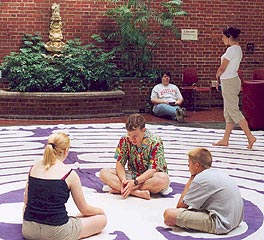
Church-Based Labyrinth Meditation Class
One example is “Ancient/Modern Spirituality,” much of which draws upon practices associated with Roman Catholic monasticism. Christian monasticism was significantly influenced by the early ascetic traditions of the Middle East, particularly the Desert Fathers, whose emphasis on solitude, ascetic discipline, prayer and contemplation had a profound influence on the subsequent development of Christian monastic spirituality.
However, some theological and mystical ideas that developed in Christian history must also be distinguished from Gnosticism, a collection of diverse movements the early Church regarded as heretical. Gnostic systems often emphasised hidden or secret knowledge (gnosis) and claimed access to spiritual knowledge beyond what was ordinarily available to believers.
Gnosticism and occultism are not historically identical, nor should they simply be treated as the same movement. Nevertheless, from a Biblical Christian perspective, pursuing secret or hidden spiritual knowledge outside Scripture’s authority raises serious concerns. Occultism itself is concerned with hidden or esoteric knowledge and practices, and Scripture repeatedly warns God’s people against seeking spiritual knowledge or power through forbidden sources.
More broadly, various forms of ancient pagan religion and mystery-cult spirituality involved claims of hidden knowledge, initiation and access to deeper spiritual realities. Some modern forms of spirituality have subsequently drawn from a mixture of ancient religious, mystical, esoteric and Eastern traditions. It is therefore important to examine carefully what spiritual practices actually teach rather than accepting them simply because they are presented in Christian terminology.
These systems can claim to impart greater or deeper knowledge and spiritual experiences than orthodox, Apostolic Christianity offers. From a Biblical perspective, this should be treated with considerable caution. Scripture warns:
“Now the Spirit speaketh expressly, that in the latter times some shall depart from the faith, giving heed to seducing spirits, and doctrines of devils.”
1 Timothy 4:1
The danger, therefore, is the introduction of non-Biblical spirituality into Christian practice and its subsequent presentation as an acceptable form of Christian devotion. When pagan, mystical or esoteric concepts are given Christian terminology, the underlying spiritual principles must still be tested against Scripture.
It would therefore be far better for “Ancient/Modern Spirituality” not to be practised at all, even in what might initially appear to be its mildest or most harmless form. The introduction of such practices into a church may be an indication that the church is moving away from the classic Evangelical and Biblical position:
“Beloved, when I gave all diligence to write unto you of the common salvation, it was needful for me to write unto you, and exhort you that ye should earnestly contend for the faith which was once delivered unto the saints.”
Jude 3
How deep-seated such a problem becomes within a church depends upon how long such practices have been permitted, whether they are subsequently normalised, and whether they are allowed to follow their “natural course of development.” What may initially appear to be an isolated or harmless practice can, over time, become established as part of the church’s accepted spirituality and eventually lead to increasingly un-Biblical concepts and practices.
What Is Meant by “Their Natural Course of Development”?
Question: What is meant by “their natural course of development”?
Answer: The “natural course of development” is that a person can be led progressively deeper into the practice of “Ancient/Modern Spirituality.” This development is not necessarily determined solely by those who participate in the practice. Those involved may simply be the human agents through whom the practice is promoted, often without fully recognising the spiritual influences or implications involved.
From a Biblical perspective, we can identify the ultimate source of spiritual deception:
Question: Who deceives?
Answer: Satan.
Scripture describes him as a liar:
“He is a liar, and the father of it.”
John 8:44
He is described as “the god of this world” who blinds the minds of those who do not believe:
Paul also warns of the danger of minds being corrupted “from the simplicity that is in Christ”:
And Scripture warns of “seducing spirits, and doctrines of devils”:
What Essentially Happens When Labyrinth Techniques Are Applied?
Question: What essentially happens when labyrinth techniques are applied according to their traditional or intended spiritual purpose?
Answer: Those who engage with the practice may find that the quiet and repetitive nature of walking the labyrinth encourages intense reflection, inward focus and the impression that thoughts, insights or spiritual impressions are being communicated to them.
This can become fascinating and may provoke an increasing desire to continue the practice in pursuit of a deeper spiritual experience or perceived breakthrough in spirituality. From a Biblical Christian perspective, this is precisely where discernment is required. What may initially appear to be peaceful meditation can become an experience through which a person becomes increasingly receptive to spiritual ideas and influences that have not been tested against Scripture.
This can become a form of spiritual enchantment—so enticing that the individual becomes increasingly drawn into the practice.
Jesus said:
“For every tree is known by his own fruit.”
Luke 6:44
The practice of “Walking the Labyrinth” is therefore presented as an experience that opens up a new dimension of spirituality. We are aware that proponents insist that labyrinths represent ancient Christian practices.
That claim requires careful examination.
The existence of labyrinths within some historical Christian settings does not establish that labyrinth walking is a Biblical Christian practice. Catholic mystical traditions and Biblical Christianity must not simply be treated as synonymous.
There are also parallels between certain forms of esoteric spirituality and practices found within other religious traditions. However, these traditions should be examined individually rather than assuming that every form of mysticism shares one single historical origin.
From a Biblical perspective, the fundamental issue remains the same: Christians are called to test spiritual claims against the Word of God rather than accepting them merely because they are presented as ancient, mystical or Christian.
A Gateway Experience into a New Dimension of Spirituality?
The labyrinth is frequently presented as a pathway towards spiritual enlightenment, healing, wholeness or deeper spiritual awareness. But the Christian must ask: What kind of spirituality is actually being entered into?
The very word labyrinth describes a complicated arrangement of winding paths and passages in which finding one’s way can be difficult. The imagery itself therefore provides an appropriate illustration for the spiritual question we are examining.
Question: What, by definition, is a labyrinth?
Answer: A labyrinth is a complicated arrangement of paths and passages, consisting of winding routes that can make finding one’s way through them difficult. It may contain numerous turns, corridors, passages and interconnected routes.
The question for the Christian is therefore this:
If we are entering a spiritual practice whose purpose is presented as leading us towards deeper spiritual awareness, do we know where that path ultimately leads—and, more importantly, do we know whether Scripture has authorised us to walk it in the first place?
We should know the way before we enter.
And yet people enter.
Why?
Views: 2
Discover more from UK Apologetics Library
Subscribe to get the latest posts sent to your email.
You must be logged in to post a comment.