
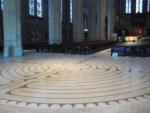
Across modern church networks, initiatives aiming to re-engage communities with the Christian faith often introduce contemporary spiritual practices. One primary example is the online and printed resource network surrounding Hope Together, which actively promotes tools like the “prayer labyrinth” for congregational and individual use.
When evaluating these spiritual resources, Scripture commands believers to test all practices against God’s Word rather than accepting them on the basis of emotional comfort or modern popularity. Ephesians 5:11 provides a clear imperative for Christian discernment: “And have no fellowship with the unfruitful works of darkness, but rather reprove them” (KJV). Believers are instructed not to treat practices as spiritually neutral when they possess documented historical and contemporary associations with alternative spiritualities, magic, and Neo-paganism.
New Testament Prayer Models vs. Labyrinth Mechanics
To evaluate the validity of using a prayer labyrinth within Christian worship, one must contrast the mechanics of labyrinth spirituality with the explicit patterns of prayer established in the New Testament.
| Aspect | New Testament Prayer Model | Prayer Labyrinth Mechanics |
| Object of Access | Direct access to the Father through Jesus Christ by the Holy Spirit (Ephesians 2:18; Hebrews 10:19–22). | Physical movement along a prescribed geometric path to reach a central point of spiritual encounter. |
| Spiritual Basis | Resting in the finished, redemptive work of Christ (Hebrews 4:14–16). | Engaging in physical, body-centered locomotion (kinesthetic ritual) to facilitate an altered or meditative state. |
| Mind & Engagement | Clear, alert, mind-engaged communication with God grounded in biblical truth (1 Corinthians 14:15; Philippians 4:6). | A three-stage progression (Inward, Centre, Outward) is designed to quiet the conscious mind and receive subjective impressions. |
| Exclusivity | Exclusively Christian prayer made in the name of Jesus Christ (John 14:13–14; 1 Timothy 2:5). | A multi-faith or open framework accommodating diverse spiritual worldviews (e.g., New Age, Neo-pagan, interfaith). |
In the New Testament, prayer is never presented as a physical spatial journey through a geometric pattern, nor does it require a “ritual gateway” or physical apparatus to facilitate communion with God. Jesus taught His disciples to pray directly to the Father in simple, clear terms (Matthew 6:6–13).
The apostles constantly emphasised bold, unhindered access to God through the veil of Christ’s flesh (Hebrews 10:19 – 20), rejecting physical techniques or esoteric rituals as prerequisites for intimacy with the Lord. Turning prayer into a physical-spatial technique risks shifting the believer’s focus from the mediator, Jesus Christ, to the method itself.
The Spiritual Practice Behind the Labyrinth
The issue cannot honestly be reduced to claiming that a labyrinth is merely a piece of artwork, a walking exercise, or an attractive pattern on the floor. In Labyrinths: Ancient Paths of Wisdom and Peace, Virginia Westbury presents the labyrinth as a spiritual device with a remarkably broad range of religious and esoteric associations.
On page 15, Westbury explicitly describes labyrinths as having “a strong tradition in magical, protective devices and symbolic entrances” (p. 15). She explains that the modern psycho-spiritual interpretation is relatively recent and that labyrinths historically served functions far beyond simple reflection. That context matters enormously when the same basic structure is introduced into Christian prayer settings.
Westbury goes considerably further. On page 17, she describes labyrinths being used by “lovers of nature, Neo pagans and Dowsers” to connect with what they understand as streams of energy within the earth (p. 17). She discusses divination, healing, eco-spirituality, nature mysticism, and the ancient Earth goddess. These are not Christian concepts suddenly appearing in an otherwise exclusively Christian practice; they are part of the wider spiritual environment in which modern labyrinth spirituality operates.
On page 19, Westbury records the diverse motives participants report for walking labyrinths: meditation, celebration, spiritual connection, talking to God, “talking to spirit,” self-exploration, healing, sensing energy, wisdom, worship, divination, inner peace, transformation, and communication with others (p. 19). She explains that Christians, Muslims, Jews, Buddhists, Neo-pagans, New Agers, and people with no religious belief encounter one another within the labyrinth, bringing beliefs about crystals, karma, angels, spirits, Jesus, Buddha, Kali, Allah, God the Father, God the Mother, and even no God at all (p. 19).
If a practice is deliberately constructed so that people from radically incompatible spiritual systems can use the same ritual space while assigning their own spiritual meaning to it, Christian leaders have a solemn responsibility to ask whether this is appropriate for Christian prayer.
Occult and Earth-Spirituality Roots
The evidence regarding the labyrinth’s background becomes explicit throughout Westbury’s documentation:
Shamanic and Esoteric Uses: On page 33, Westbury discusses the labyrinth’s potential shamanic uses, including ritual dances, fertility rites, oracles, death and rebirth, and rites of passage within Bronze Age Mediterranean and Middle Eastern religious contexts involving priests, healers, soothsayers, and magicians (p. 33).
Mythological and Sacred Spaces: On page 35, she discusses the labyrinth as a sacred mountain, a realm between humans and gods, and a location carrying imagery of caves and wombs of rebirth (p. 35).
Mystery Religions: On page 43, she connects labyrinths with mystery religions, describing traditions involving esoteric practices, spiritual journeys, and tools for initiation into mysteries (p. 43).
Magical Protection: On page 44, she outlines Scandinavian labyrinth traditions, including the “Maiden’s Dance,” fertility symbolism, and magical protective devices (p. 44).
Church Adaptations: On page 51, she discusses church labyrinths, including the one at Chartres Cathedral, and describes theories that they functioned as “protective devices, ritual gateways and sanctuaries” (p. 51).
Why would the church ever require a physical ritual gateway? The New Testament does not teach Christians to approach God through a physical pathway, an esoteric symbol, or a sacred geographical pattern.
Jesus saith unto him, I am the way, the truth, and the life: no man cometh unto the Father, but by me.”
John 14:6 (KJV)
Christ is the way not the labyrinth.
From Esoteric Device to Modern Church Practice
The primary concern is not merely that non-Christian traditions have used labyrinths, but that the modern labyrinth movement openly accommodates a syncretic mixture of spiritual systems.
On page 79, Westbury describes the labyrinth as a “spiritual device” for finding deeper meaning and encountering the divine, whatever a person conceives the divine to be (p. 79). On page 80, she describes its use in churches, noting that for ministers the labyrinth aids body-centred forms of prayer, including dance and ritual, leading to reported mystical states and communion with spirit energies (p. 80). Adding words like “Jesus,” “Bible,” or “prayer” to a practice does not automatically transform an underlying spiritual methodology into something God has commanded.
Westbury’s documentation on pages 89 to 90 makes the occult connection explicit:
- She details Alex Champion, a dowser and professional labyrinth maker, noting that for practitioners of earth-based spirituality, dowsers, goddess worshippers, and Neo-pagans, the labyrinth functions as a device for focusing earth energies and connecting with nature spirits (p. 89).
- She outlines labyrinths being used for seasonal celebrations such as solstices and equinoxes to connect with an ancient goddess figure (p. 89).
- She notes Champion’s personal experiences of connection with the labyrinth, including vivid dreams, euphoria, visions, and physical sensations (p. 90).
The fundamental question is whether churches should knowingly adopt a spiritual practice whose documented practitioners include Neo-pagans, goddess worshippers, dowsers, and those seeking contact with spirit energies.
Promotion Across Hope Together Resources
This documented background directly connects to published material promoted by Hope Together Online and its affiliated print resources.
In Hope: Heartbeat of the Mission, the “Harvest Labyrinth” is described as a “12th century ritual” adapted for the twenty-first century, presented as a path involving reflection, interaction, and prayer regarding one’s spiritual journey, community, and the planet (p. 124). It is explicitly recommended for use in a church or church hall alongside a Harvest supper or community activity, featuring stopping points with soil, seeds, water, and bread (p. 124).
The same concept appears in Hope for the Harvest (p. 97). Furthermore, Hope in Our Towns, Villages and Cities explicitly recommends using a “prayer labyrinth,” dividing the process into three stages: an inward journey, a centre for prayer and meditation, and an outward journey concerning the surrounding world (p. 86). Additionally, Hope for the Future describes cathedral overnight programmes containing prayer bands, prayer graffiti, a prayer labyrinth, and Taizé-style meditation (p. 118).
When Westbury’s documentation of the labyrinth’s wider spiritual ecosystem is placed alongside the promotion of labyrinths in Hope Together material, the connection demands serious biblical evaluation.
The Biblical Call for Discernment
Scripture instructs the church:
“And have no fellowship with the unfruitful works of darkness, but rather reprove them.“
– Ephesians 5:11 (KJV)
“Prove all things; hold fast that which is good.“
– 1 Thessalonians 5:21 (KJV)
The biblical mandate is not to take a device associated with other spiritual systems, place it inside a church building or promote it online, attach Christian terminology to it, and assume it has been sanctified. The command is to reprove, to expose, bring to light, and challenge what is contrary to God’s Word.
Everything must be tested. This includes practices promoted in modern ministry networks, featured in church resource books, or implemented inside church halls. An individual’s report of peace, insight, or powerful emotional experiences does not prove the practice originated from God. Personal experience must yield to the standard of Holy Scripture.
The Danger of Christianizing Unbiblical Practices
The overarching concern with the resources distributed by movements like Hope Together is the failure to apply strict biblical testing to imported methods. A spiritual practice with documented ties to magic, Neo-paganism, goddess spirituality, dowsing, earth energies, and mystery religions has been presented within Christian contexts as a valid vehicle for prayer.
Where does Scripture authorize the church to use a labyrinth for prayer? There is no such command. God has already provided His church with everything required for life and godliness:
- The Holy Scriptures
- Direct Prayer
- Christian Fellowship
- True Worship
- The Holy Spirit
“For through him we both have access by one Spirit unto the Father.”
– Ephesians 2:18 (KJV)
Believers do not need an occult-derived technique to gain access to God. The church has no authority to import practices Christ never commanded. When evidence once shows associations with practices Scripture expressly condemns, the only appropriate Christian response is not experimentation but biblical discernment, separation, and warning.
Here is the complete reference list of all Scripture passages and published books cited in the article, organized in academic footnote format.
Footnotes & References
Scripture Passages (King James Version)
- Deuteronomy 12:30–31 — Prohibition against adopting pagan religious rites and spiritual methods for the worship of Yahweh.
- Deuteronomy 18:10–12 — Warning against divination, enchantment, witchcraft, spiritism, and necromancy.
- Matthew 6:6–13 — Christ’s instruction on direct, personal prayer to the Father (The Lord’s Prayer).
- John 14:6 — Declaration of Jesus Christ as the exclusive way, truth, and life.
- John 14:13–14 — The model of Christian prayer offered directly in the name of Jesus Christ.
- Acts 17:11 — The Berean principle of searching and testing all teachings against Holy Scripture.
- 1 Corinthians 14:15 — Mandate for clear, mind-engaged prayer and spiritual understanding.
- 2 Corinthians 11:14 — Warning regarding spiritual deception and counterfeit revelations.
- Ephesians 2:18 — Assurance of direct access to the Father through the Spirit by Jesus Christ.
- Ephesians 5:11 — Command to have no fellowship with unfruitful works of darkness, but rather expose and reprove them.
- Philippians 4:6 — Instruction for cognitive, petition-based prayer with thanksgiving.
- 1 Thessalonians 5:21 — Command to test all spiritual claims and practices, holding fast only to that which is good.
- 1 Timothy 2:5 — Proclamation of Jesus Christ as the sole Mediator between God and mankind.
- Hebrews 4:14–16 — Bold access to the throne of grace through Christ, our High Priest.
- Hebrews 10:19–22 — Access into the Holiest by the blood of Jesus, bypassing physical rituals or gateways.
Book Sources
- Westbury, Virginia.Labyrinths: Ancient Paths of Wisdom and Peace. Dublin: Gill & Macmillan / HarperCollins, 2001.
- Page 15: Labyrinths as protective devices, magical symbols, and ritual entrances.
- Page 17: Associations with Neo-pagans, dowsers, earth energies, divination, and nature mysticism.
- Page 19: Diverse participant motivations and multi-faith integration (Neo-pagan, Christian, Buddhist, New Age, etc.).
- Page 33: Shamanic functions, fertility rituals, oracle sites, and rites of passage in antiquity.
- Page 35: Sacred mountain, cave, and womb imagery in ancient religions.
- Page 43: Mystery religions, initiation rituals, and esoteric spiritual journeys.
- Page 44: Scandinavian “Maiden’s Dance” and magical protective devices.
- Page 51: Church labyrinths (e.g., Chartres) interpreted as ritual gateways and protective symbols.
- Page 79: Labyrinth defined as a “spiritual device” for encountering the divine under any definition.
- Page 80: Body-centered/kinesthetic prayer, dance, and communion with spirit energies in church settings.
- Pages 89–90: Alex Champion (dowser), focusing earth energies, solstice celebrations, and goddess spirituality.
- Hope Together / Hope Resources (London: Hope Publishing / Church House Publishing):
- Hope: Heartbeat of the Mission (p. 124) — Introduction and adaptation of the “Harvest Labyrinth” as a 12th-century ritual.
- Hope for the Harvest (p. 97) — Promotional guide for incorporating harvest prayer labyrinths.
- Hope in Our Towns, Villages and Cities (p. 86) — Outlining the three-stage prayer labyrinth progression (Inward, Center, Outward).
- Hope for the Future (p. 118) — Resource detailing overnight cathedral prayer events, prayer labyrinths, and Taizé meditation.
Views: 2
Discover more from UK Apologetics Library
Subscribe to get the latest posts sent to your email.
You must be logged in to post a comment.